William Johnson Quotes
The Eyes of all the Western Tribes of Indians are upon the behavior of the Six Nations [Iroquois]
The Iroquois were generally recognized, even by the other tribes and nations, and the most advanced and most powerful of the Native Americans. Their example was critical in shaping the policies and behavior of all the Indians. At the time “Western” Indians referred to those in Pennsylvania, Ohio, Kentucky, Illinois and those West of the Eastern seaboard. West Coast and Plains Indians were not known generally known to the colonists and those nations had no knowledge of the Iroquois. Johnson himself married an Iroquois woman.
William Johnson, 1715–1774, Superintendent of Indian Affairs for the Northern Colonies of British America, Major General of the English Forces in North America, Statement to the British Board of Trade, June 1754
Sourced by: Eigen's Political and Historical Quotations

Indian treaties had legal problems from the beginning of the nation. An agreement had been made at Fort Harmar with 6 Indian nations. One man signed for the United States and several of the sachems, for the Indians. President Washington reported this to the Senate and there was much confusion as to how to proceed. Typically, agents for nations negotiated a treaty but it would not be binding until each ratified it. To the Indians this was not a familiar practice. In this case, the treaty was approved for ratification by the Senate, but what kind of ratification was to be required of the Indians? The Iroquois Indian tribes had formal, methods of reaching consensus, but other nations did not. Whites sometimes reneged on later treaties on the grounds that they were not ratified by the Indian nations. In others, the Indians themselves made the same claim and challenged the right of the Indian treaty signers to speak for the tribe or nation. The problem has never been resolved.

President Thomas Jefferson and the Congress worked at making a workable set of relationships with the Indians. Here Congress gave Jefferson a fund so that he could invite influential Indian leaders to Washington and give them presents. The hope was that the Indian leaders would see the achievements of white society and then work to transform their people to this more desirable way of life. While this was a good strategy with a few Indian nations, the reaction of most Indian leaders was being very impressed but not really wanting to trade their existing lifestyle, customs and values for the undeniable advantages that American society could bring. Both the white and Indian leadership miscalculated, Jefferson believed that as soon as the Indian leaders could examine the two alternative societies, they would clearly choose to change. The Indians were so impressed with the sincerity, reasonableness, and friendliness that the white leadership exhibited, that the Indians did not realize that a large part of white society was different from the leadership and that the leaders spoke for and could control the other whites.


The Iroquois had a very successful confederacy of 6 tribes in a relatively democratic government with a written constitution. They dominated the Eastern part of North America for years. The were able to maintain a permanent unity with a unified and decentralized combination of government—much like the United States would become. At the time of this advice, each American colony was a government unto itself. The three Iroquois Indian delegates were Canassatego, Tachanoontia, and Gachradodow.

In a tragic irony, the two chiefs were killed by a year later at the Sand Creek Massacre.

Like many of Jefferson’s ideas, this one had great merit but could not be enforced. The idea was to establish “trading houses” amongst the Indians which would operate on a NON PROFIT basis. However, fraud and corruption on the part of the managers of these trading houses in most cases left the Indians with far less than the fair market value of their goods and the “white” commodities were sold at inflated prices. Jefferson also believed in minimal government so he never set up any kind of audit mechanism or supervisory system of the “trading houses” and instead of helping the Indians often cheated them even more than private traders would.


Tecumseh had for the only time in history formed a confederation of Indian tribes who put aside their individual rivalries and unified to stop the white encroachment on their lands. Harrison, in charge of the American troops, tried to deal separately with the old chiefs and the separate tribes. Tecumseh forced him to deal with the Indians as a whole.


This law governed the territories outside of the original 13 colonies. The intentions of the founding fathers and the first Congress to the Indians was fair and honorable. However, there was no practical way that the new Federal Government could enforce this principle in the territories. A single greedy land speculator or trader could abuse a group of Indians and start a small war. The vast cultural differences between Indians and whites tended to polarize all violent conflicts regardless of who was at fault. The different perceptions of cruelty and atrocities further pushed the government to defend whites violating national policy and there was sufficient corruption and money to be made on Indian land and trading and things went downhill fast.

The French had launched a sneak attack on the English settlement at Schenectady, NY. The English had not provided enough security to Schenectady and now considered withdrawing from the upstate area. Contrary to the popular conception of all the Indians being invaded by the Whites and fighting it, here these Indians were urging the English to hang on and stay in the area. The Mohawk were one of the tribes of the Iroquois confederation which were very sophisticated, somewhat democratice, and very powerful economically and militarily. To them, the English were good trading partners and unlike the French tended to conform with Iroquis norms, rules and mores. It also illustrated the closeness of the alliance of these Indians with the English against the French in the French & Indian Wars.

This is one of the first Policy Statements of the new Republic about the Indians. Essentially, although the government policy was reasonable and fair, public opinion was totally different and the leadership could not persuade the people on this point. One complicating factor was the fact that most of the Indian tribes had overtly or covertly sided with the British in the Civil War. Many Indians were exiled to Canada. Even the Indians who were American allies, had their lands encroached upon however.


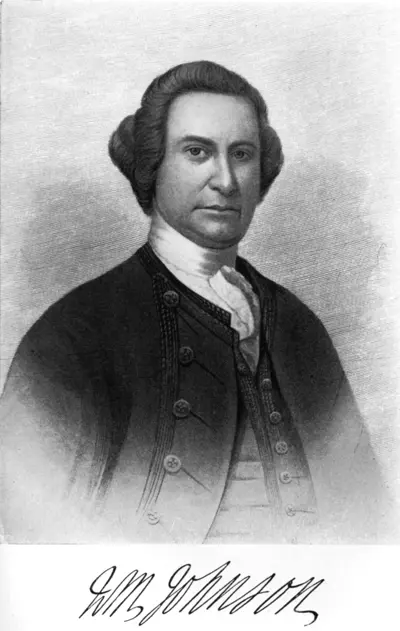
Sir William Johnson, 1st Baronet, was an Irish official of the British Empire. As a young man, Johnson moved to the Province of New York to manage an estate purchased by his uncle, Admiral Peter Warren, which was located amidst the Mohawk, one of the Six Nations of the Iroquois League. Johnson learned the Mohawk language and Iroquois customs, and was appointed the British agent to the Iroquois. Because of his success, he was appointed in 1756 as British Superintendent of Indian Affairs for the northern colonies. Throughout his career as a British official among the Iroquois, Johnson combined personal business with official diplomacy, acquiring tens of thousands of acres of Native land and becoming very wealthy.
