Henry A. Kissinger Quotes
We are all the President's men.
Henry A. Kissinger, U.S. Secretary of State (Republican), U.S. National Security Advisor, 1975
Sourced by: Eigen's Political and Historical Quotations


Alberto Gonzalez, White House Counsel and later Attorney General who was forced to resign and David S. Addington, Counsel to the Vice President, had come up with a novel view of the powers of the presidency. They argued that since the President is the Commander in Chief, in a war situation or intelligence gathering thereto, has the Constitutional responsibility for that function, he need not obey any laws of Congress as in the conduct of the war Congress would be impinging on the Constitutional separation of powers which itself was prohibited by the Constitution. The argument did not find any significant legal support but for a while the George W. Bush White House behaved as if this were the law, despite the fact that even in the American Revolution and the War of 1812 Congress passed laws regulating the conduct of the armed forces as is provided for in other parts of the Constitution. Yet even Goldsmith would allow the President some powers that many think are unconstitutional and/or belong to Congress. See {32436}.


Played the President in the NBC Network West Wing


He was asked if he supported President Donald Trump, whose first 100 days was in the view of most political analysts, historians and many politicians--almost all Democrats and even many Republicans to be one of the worst on record. His popular approval rating was the worst after 100 days than any other President since support polls had been started. Kasich had stringly opposed Trup in the 2016 election. His answer reflected his view that al should support whatever president was in office even thought they might at the same to be very critical and opuitspoken about his weaknesses and failings. The President is everyone's President even though he may not act like it.


This was a very clever play on a slogan that Las Vegas was using at the time to promote tourism and gambeling: “What happens in Las Vegas stays in Las Vegas”


That is one view—the one tried the most frequently by Presidents who by their own estimates didn’t get a responsive civil service working to his priorities. Presidents like Teddy Roosevelt, Franklin Roosevelt, and Dwight Eisenhower and Lyndon Johnson had great cooperation from their civil servants; they instead appointed very competent people with strong senses of fairness and leading personnel. Ronald Regan tried both techniques. He used Wilson’s technique in his Education and Justice Department where there was slow-rolling and dissonance when his appointees tended to be ideologues with little or no outstanding professional competence in the fields they supervised. However, his military and State Department bureaucracies was very responsive to his appointees who were excellent leaders.

During his Ambassadorial confirmation hearings Helms lied about the role the CIA under his direction had played in the destabilization of Chile and the Allende administration. In 1977 he was convicted of perjury. He was not convicted for carrying out any presidential orders but for lying under oath to Congress. No President had ordered him to do that. The CIA had covertly aided in a coup usurping the popular, elected President Salvador Allende—today a national hero in Chile. We picked the wrong side in the political battle in Chile. We helped a military dictator overthrow a democratically elected president. See {622168}.

Much obviously is but every President and his White House deals with issues and problems where there is no time or opportunity to take the effect on electoral politics into consideration. Many actions are taken without any such consideration, sometimes to the regret of the President’s political staff. Even then, the press tends to believe that it was a blunder, that the White House misjudged public opinion or the like when in reality, the President and staff never even considered it.


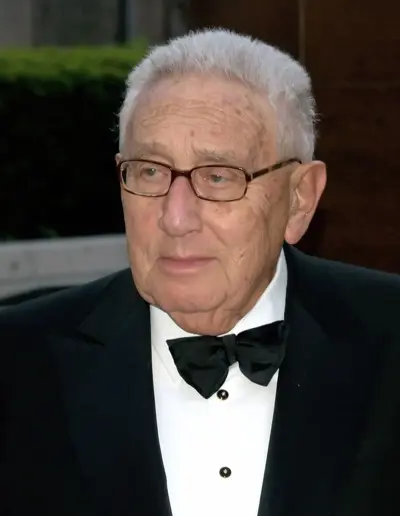
Henry Alfred Kissinger KCMG is an American politician, diplomat, and geopolitical consultant who served as United States Secretary of State and National Security Advisor under the presidential administrations of Richard Nixon and Gerald Ford. A Jewish refugee who fled Nazi Germany with his family in 1938, he became National Security Advisor in 1969 and U.S. Secretary of State in 1973. For his actions negotiating a ceasefire in Vietnam, Kissinger received the 1973 Nobel Peace Prize under controversial circumstances, with two members of the committee resigning in protest.
