Edward Coke Quotes
Was it ever known that general words were a sufficient satisfaction for particular grievances …. When grievances are complained of, the parliament is to redress them.
The king had forced subjects to lend him money and other violations of English tradition and laws. The house debated more stringent restrictions on the power of the king, who instead sought to assure parliament that the practice would not continue and was only an emergency measure.
Edward Coke, 1552-1634, English Solicitor General, Attorney General and Speaker of the House of Commons, House debate, 1628
Sourced by: Eigen's Political and Historical Quotations

The editorial was in support of women’s suffrage—the right to vote which at the time women did not have in Britain. Women were very active in protests and demonstrations. Tactics sometimes involved civil disobedience and chaining themselves to public buildings. It was the civil disobedience and disruptions that the newspaper referred to as the “follies and excesses.” In retrospect today, it is amazing how threatened the society felt and how they reacted to the “threat” of females voting. It does however give us a perspective on those contemporary societies which restrict women’s voting rights.


as opposed to the President. Baird asked President Clinton to withdraw her nomination when controversy erupted during her confirmation hearings over her hiring illegal aliens as domestics.


The colonists in America had no representatives in Parliament. Galloway who opposed armed rebellion against Britain {621966} admitted that the British treatment of America was wrong but saw other solutions. It will never be known if any of them might have worked. The world would have been very different had they been tried.


In the English system the checks and balances of the American system are not present. Historically in England the Monarch and the Parliament acted as checks upon each other. With a Constitutional Monarch there is no institutional check on Parliament. The checks are their restraint--respect for precedent--and the voters. The Prime Minister is a member of Parliament and has no powers other than what Parliament gives him/her. The courts in England are under Parliament and the upper house, the House of Lords is the equivalent of the highest court—but it may always be overruled by the parliament itself.


After Adams’ term as President, he was elected to the House of Representatives where he served for the rest of his career. He was constantly calling for the emancipation of slaves (see {77463}) in the House debates. The Southern Congressmen were so offended by this that they got the majority of the House to pass a rule that made using the word “slavery” out of order. It was called the “Gag Rule”. Adams, one of the best legislators and lawyers of his day, then started reading in the House debates petitions of his constituents calling for an end to slavery. The Southerners called for the Speaker to declare him out of order for violating the gag rule. But Adams pointed out that the Constitution gave citizens the right to petition Congress with no controls on the petitions. Therefore the reading of the petitions was Constitutionally mandated and trumped the Rules of the House. He then arranged to have many petitions submitted which he dutifully read on the House floor to the extreme anger of the Southerners.


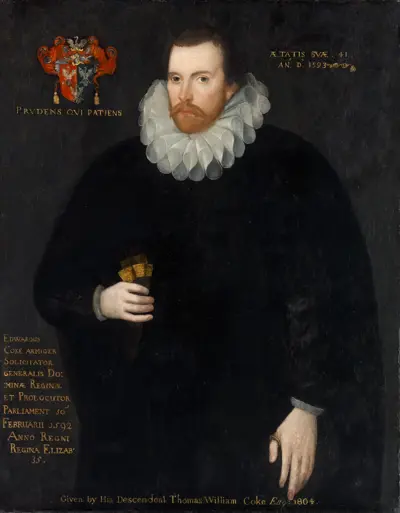
Sir Edward Coke SL was an English barrister, judge, and politician who is considered to be the greatest jurist of the Elizabethan and Jacobean eras.
