Nelson A. Miles Quotes
… utterly subversive to the interest of the military establishment.
At the time, there were no civilians staff such as the Assistant Secretaries of the individual services and Assistant secretaries of Defense. All military staff work, policy and operations, were done completely by military personnel.
Nelson A. Miles, 1835-1925, General and Commander in Chief of the U. S. Army, Description of the concept of having a civilian general staff in control of the military, Senate Testimony, Quoted in The Washington Star, April 19, 1902
Sourced by: Eigen's Political and Historical Quotations


America is almost unique among nations where the military has never been a force that either dominated or controlled the government or acted independently from it. The Founding Fathers knew well the history of Europe and other nations, and built many checks into our Constitution and our traditions with George Washington, setting the example for American military men forever after.

He fought in Algeria and other counterinsurgencies and then studied them. He wrote the classic book on counterinsurgency warfare. After all the mistakes the U. S. made after the successful invasion of Iraq, his book and doctrine were very influential in the change in strategy and tactics that turned the Iraq War in our favor.


The Army and the other power centers of the country did not appreciate this idea. He was assinated in a coup 4 year later.


MacArthur had been the Commander of our Military Forces in Korea. He had a huge ego, and he wanted to cross the border and attack China since Chinese Troops were aiding the North Vietnamese. He had previously assured the Joint Chiefs of Staff and the President that the Chinese would not send troops into Korea, but he was then wrong. And when they had attacked, they had erased the territorial gains that MacArthur had previously gained. The Joint Chief’s of Staff, the Secretary of Defense and the Secretary of State had decided upon a strategy which this time did not follow MacArthur’s strategic advice. The President approved the strategy, but MacArthur spoke and acted contrary. The President met with MacArthur and reiterated the strategy that the President approved. But MacArthur did not follow the orders of the Joint Chiefs. At the time, he and Eisenhower were America’s two most famous military leaders, and of the two MacArthur was senior and thought that he should be President. After he was fired, MacArthur addressed a Joint Session of Congress and gave his "Old Soldiers Never Die" speech which was his first active step towards the Presidency. It was a very sentimental speech with little content and nothing about why he had disobeyed orders. He was totally shocked when it was Eisenhower who was selected to run for President and not him.


This quotation is often cited as it presages the concept of the Military Industrial Complex that was given by President Eisenhower in 1961--{641114}. It is not known whether Eisenhower had read or was briefed on this Mills quotation.

There was no provision then for wounded and elderly soldiers. Madison’s suggestion was the beginning of the idea of The Veterans’ Administration which it would evolve into many years later.
SCAF: Supreme Council of the Armed Forces. This quotation illustrates how difficult it is to establish a real democracy in Egypt in particular and most Middle Eastern countries in general. Essentially, the General wants to be sure that there is no check or control on the military in the new dupposedly democratic system. In a democracy, there are only two elements that the people have selected and who represent them—the President and the Parliament. If neither of these can command and control the military, then the people have no control over the military which then becomes a de facto aristocracy that has a veto on everything in the country. Making the situation more difficult is the fact that in Egypt (as in many non democratic nations) the military owns and controls a very large segment of businesses throughout the economy—more than any corporation or wealthy family. The civilian control of the military—one of the most fundamental aspects of the United States and every other true democracy—will not likely be possible in Egypt in the next decade or so.


She was a nondescript minor functionary in a Tea Party Active Southern County, and her hatred of the Black president was hardly noteworthy. What makes this an important quotation is that it was frequently shown to foreigners who really did not understand the great degree of freedom of speech. Here a public official being paid by the government, not only calls for the removal of a sitting president, but also openly asked the army to rebel against their commander in chief. She was not punished, nor even arrested or tried. She was not even dismissed from her elected government job. That was up to the voters in the next election. There likely is no other country in the world where that can happen.


We generally do not associate Switzerland with military capability, buut in the 15th century they had one of the best fighting forces in Europe.

There is frequently a disagreement between the military and civilian leaders just as there are disagreements among most political personnel. Hawks, and people who have had experience in the military tend to think that military advice on military matters should be determinative with the President and Congress. Others tend to believe that military advice should be considered, but if it were always adhered to, there would be no point in having civilian control over the military. See {639667} for an example of when military leadership advice prevailed and it was a mistake.

If a military loses a war, it has shown to be insufficient quality; if it wins, the evaluation is good. With all the talk about what makes for an effective and quality military, as the General states, it is war that is the final arbitrator. So ideally we never want to really know how good our military is.


Generally, the American military is much more optimistic of its ability to accomplish its objectives as that it the way they have been trained. The General warns that the same attitude will make them more optimistic and willing to tackle a very difficult if not impossible problem than most would be. So civilians in America have to question what they are doing. At the same time, there have been a number of highly sophisticated military officers who have both a military and civilian perspective and education. They tend to be more realistic and at times argue against military deployments and missions that are being considered. However, once deployed and committed, it is culturally difficult or impossible for a member of the military to be pessimistic about the eventual
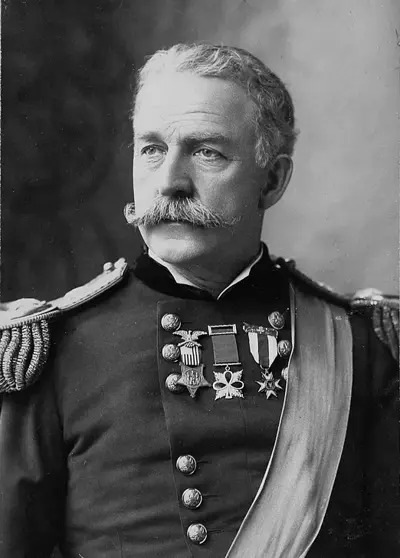
Nelson Appleton Miles was an American military general who served in the American Civil War, the American Indian Wars, and the Spanish–American War. From 1895 to 1903, he served as the last Commanding General of the United States Army before the office was abolished.
