Karl Marx Quotes
Usury lives in the pores of production, as it were, just as the gods of Epicurus lived in the space between the worlds.
Marx, Karl. Capital: A Critique of Political Economy, Vol. 3. Charles H. Kerr & Company, 1909, p. 700.


Marx believed that the system of capitalism if it succeeded would be forced to globalize. To him, globalization was an inevitable consequence of capitalism itself and purely national industries would be destroyed.

Ford was a notorious anti-Semite. He was also an enthusiastic supporter of Hitler and the German Nazi’s. He considered a run for the Presidency and published a highly political company newspaper, and thus was much more of a public figure than most industrialists. Later, he issued an apology and claimed that he never really was anti-Semitic. See {586941}.


Money was backed by gold then and therefore limited and the country was growing, and needed more money to finance development. But the only way to then have more money in circulation was for the government to borrow it from the people who had it—mostly wealthy people in the East and in England. These gold owners charged very high interest rates. However there was much more silver in the U. S. and more was being mined every day. So for many populists, the answer was to make silver a basis for money. But those who had gold backed money wanted to maintain the shortage of currency in the growing nation The populists naively thought that if there was sufficient money supply all other problems like labor strife would disappear. Some did when the money supply was finally expanded, but it was no panacea.


Ironically, Fitzhugh who detested socialism, held this basic socialist principle. His solution however, was that the profits were necessary for society, and therefore slavery was the solution for Blacks AND whites.

Essentially, the Council voted to close all the banks of the day and get rid of all the bankers. Without banking economic development of Christian (Catholic) Europe stagnated and did not thrive until the Borgia’s used their banking prowess to actually attain the Papacy. Ironically, Christians, Jews and Muslims all had banned banking—usury—the charging of interest for borrowed money—as a serious sin. To this day there are orthodox fundamentalists of all three religions who decry modern banking, but the majority of Christians and Jews no longer have any problem with banking, and while the Muslims generally still decry it as a sin, the wealthy Muslims have come up with various fig leaves where they pretend that banking us not usury, and in the modern world, although they are castigated by a mullah or two, the essence of capitalism goes on even in Muslim countries.


This was the equivalent of 8.3 percent.


Manava Dharma Shastra. Ancient Jewish law prohibited the charging of interest. The early Christian world frowned upon it and morally and legally vacillated from time to time. Islam outlawed interest completely and some orthodox Muslims and Muslim counties loans with interest are illegal. However the ancient Hindus not only allowed interest but felt that it was such an important component of the economy that there were numerous regulations, religions and legal regulating it. This example made 5 percent the maximum allowable interest rate. This text is a part of the Hindu Holy Texts. Hindus believe that Manu was a prophet whose text is revealed or inspired.
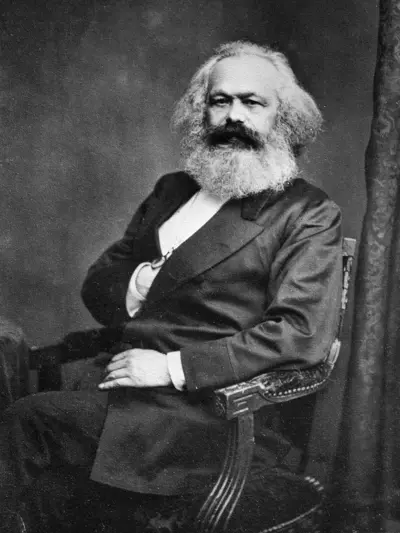
Karl Heinrich Marx was a German philosopher, economist, historian, sociologist, political theorist, journalist and socialist revolutionary. Born in Trier, Germany, Marx studied law and philosophy at university. He married Jenny von Westphalen in 1843. Due to his political publications, Marx became stateless and lived in exile with his wife and children in London for decades, where he continued to develop his thought in collaboration with German thinker Friedrich Engels and publish his writings, researching in the reading room of the British Museum. His best-known titles are the 1848 pamphlet The Communist Manifesto and the three-volume Das Kapital (1867–1883). Marx's political and philosophical thought had enormous influence on subsequent intellectual, economic and political history. His name has been used as an adjective, a noun, and a school of social theory.
