Second Council Of Lyons Quotes
Wishing to close up the abyss of usury, which devours souls and swallows up property …. expel all such notorious usurers from their territories within three months, never to admit any such for the future. Nobody is to let houses to them for usury, nor grant them houses under any other title. Those indeed who act otherwise, if they are ecclesiastical persons, patriarchs, archbishops or bishops, are to know that they incur automatic suspension; lesser individual persons, excommunication, colleges or other communities, interdict. If they remain obdurate throughout a month, their territories shall lie henceforth under ecclesiastical interdict as long as the usurers remain there
Essentially, the Council voted to close all the banks of the day and get rid of all the bankers. Without banking economic development of Christian (Catholic) Europe stagnated and did not thrive until the Borgia’s used their banking prowess to actually attain the Papacy. Ironically, Christians, Jews and Muslims all had banned banking—usury—the charging of interest for borrowed money—as a serious sin. To this day there are orthodox fundamentalists of all three religions who decry modern banking, but the majority of Christians and Jews no longer have any problem with banking, and while the Muslims generally still decry it as a sin, the wealthy Muslims have come up with various fig leaves where they pretend that banking us not usury, and in the modern world, although they are castigated by a mullah or two, the essence of capitalism goes on even in Muslim countries.
Second Council Of Lyons, Lyons, France, 1274
Sourced by: Eigen's Political and Historical Quotations

Those who devour interest will not stand except as stands one whom Satan has driven mad by his touch
Interest is forbidden in all transaction, both business and personal.

There were little controls over usury in his time in India. Villagers often paid 500% or more to borrow money in a necessity like needing critical health care.


If there would be free competition in banking as opposed to monopolies in each area, This is the first major history of banks written in the United States. At the time, there was hardly any competition amongst banks. Each bank had a do facto or official monopoly in its area. In many communities of America, this is still true, but competition in banking has reached almost all high density areas of the country.

Interest is forbidden in all transaction, both business and personal.


North was none-the-less in favor of allowing interest rates be much higher, but was stating the best argument, believed at the time by most English experts, and many American economists today.


Stamp was a banker and the 2nd richest man in England at the time. Yet he warned about aspects of banking that needed reform and regulation.

The last sentence echoes a quotation of Napoleon. See {630664} .

He was against paper money. At the time, any bank could issue its own paper money or “banknotes”. However other banks would not redeem the banknotes for the full amount; they would “discount” the note. Usually, the further away the bank was from the original bank, the more discount they took. Interstate commerce was almost impossible. Alexander Hamilton, Jefferson’s nemesis, had a much more modern point of view and fortunately his view prevailed. Paper money could only work if it was issued by a central bank with no discounting by other banks. The paper money had to be “legal tender”.


This was in the midst of the debate over The Recharter Of The Bank bill

Stamp was a banker and the 2nd richest man in England at the time. Yet he warned about aspects of banking that needed reform and regulation.

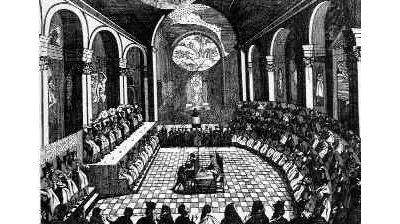
The Second Council of Lyon was the fourteenth ecumenical council of the Catholic Church, convoked on 31 March 1272 and convened in Lyon, Kingdom of Arles (in modern France), in 1274. Pope Gregory X presided over the council, called to act on a pledge by Byzantine emperor Michael VIII to reunite the Eastern church with the West. The council was attended by about 300 bishops, 60 abbots and more than a thousand prelates or their procurators, among whom were the representatives of the universities. Due to the great number of attendees, those who had come to Lyon without being specifically summoned were given "leave to depart with the blessing of God" and of the Pope. Among others who attended the council were James I of Aragon, the ambassador of the Emperor Michael VIII Palaiologos with members of the Greek clergy and the ambassadors of Abaqa Khan of the Ilkhanate. Thomas Aquinas had been summoned to the council, but died en route at Fossanova Abbey. Bonaventure was present at the first four sessions, but died at Lyon on 15 July 1274. As at the First Council of Lyon, Thomas Cantilupe was an English attendee and a papal chaplain.
