SECOND COUNCIL OF LYONS
(Second Council of Lyon)
Essentially, the Council voted to close all the banks of the day and get rid of all the bankers. Without banking economic development of Christian (Catholic) Europe stagnated and did not thrive until the Borgia’s used their banking prowess to actually attain the Papacy. Ironically, Christians, Jews and Muslims all had banned banking—usury—the charging of interest for borrowed money—as a serious sin. To this day there are orthodox fundamentalists of all three religions who decry modern banking, but the majority of Christians and Jews no longer have any problem with banking, and while the Muslims generally still decry it as a sin, the wealthy Muslims have come up with various fig leaves where they pretend that banking us not usury, and in the modern world, although they are castigated by a mullah or two, the essence of capitalism goes on even in Muslim countries.
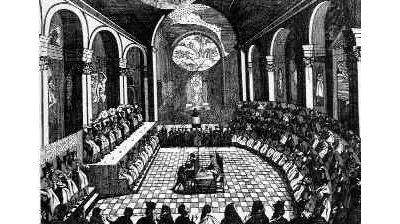
The Second Council of Lyon was the fourteenth ecumenical council of the Catholic Church, convoked on 31 March 1272 and convened in Lyon, Kingdom of Arles (in modern France), in 1274. Pope Gregory X presided over the council, called to act on a pledge by Byzantine emperor Michael VIII to reunite the Eastern church with the West. The council was attended by about 300 bishops, 60 abbots and more than a thousand prelates or their procurators, among whom were the representatives of the universities. Due to the great number of attendees, those who had come to Lyon without being specifically summoned were given "leave to depart with the blessing of God" and of the Pope. Among others who attended the council were James I of Aragon, the ambassador of the Emperor Michael VIII Palaiologos with members of the Greek clergy and the ambassadors of Abaqa Khan of the Ilkhanate. Thomas Aquinas had been summoned to the council, but died en route at Fossanova Abbey. Bonaventure was present at the first four sessions, but died at Lyon on 15 July 1274. As at the First Council of Lyon, Thomas Cantilupe was an English attendee and a papal chaplain.
