Joseph Joffre Quotes
Troops that can advance no farther must, at any price, hold on to the ground they have conquered and die on the spot rather than give way.
Joseph Joffre, 1852-1931, French General and Commander in Chief, Order given at the beginning of the Battle of the Marne, September 5, 1914
Sourced by: Eigen's Political and Historical Quotations

He was not supported and a peace was negotiated with the British. De la Rey became a Senator and later was shot while trying to organize another rebellion.


The Germans and Americans did this as a standard practice. The French “history” to which the General referred did not involve machine guns and mortars. The entrenching tool (shovel) was a fundamentally important piece of equipment to the Germans and Americans but not the French at the beginning of WWI. Later in the war, the French finally learned.

Almost three years later, Lee surrendered Richmond to Ulysses Grant.


Churchill saw before many others that technology and weaponry had changed the nature of warfare. At the time the military leadership of all the major powers were pursuing 19th century tactics with 20th century weaponry including mass bayonet charges against machine guns behind barbed wire. Churchill and other civilians, although they had legal control over the military, had little de facto tactical control. As a politician he became an itinerant meddler in military tactics thereafter.

This appears to be the origin of the “bear the unbearable” phrase which appeared in many other documents around the Japanese surrender. See {604741}


By the 21st century, there were few who would agree with Roosevelt on this point. The contributions of inventors and scientists and then business men and financiers.

Japan and 7 Western countries had sent military troops to China ostensibly to protect “foreigners” who were the victims of the irrational violence of the Boxer Rebellion--{641726} and {641727}. The Chinese government was unwilling and/or unable to suppress the Boxers--{641838}. Regardless of the justification, this was an act of war—an invasion contrary to international law. The Chinese national forces were not only too weak to take on the Boxers but were no match for the 8 powers’ well equipped military forces. None-the-less, the Empress decided to fight. In the early fighting the Chinese Imperial forces killed the German Minister to China, Baron von Ketteler, thus precipitating full scale war.


Even in democratic America, this has been true. We spend almost any amount of money to give our military the weapons of war that will make them more effective soldiers, but when they return with mental and physical wounds, government money is not so easy to come by to preserve them in good health. Cost is a major consideration in Veterans benefits and care, but weapons expenditures have little restraint. It has been so for many years in many cultures.


The Chinese were massacred when the Japanese invaded with atrocities against civilians that were inconceivable until Hitler began his in Europe. However, there were many Chinese we worked against the Japanese including the Communists who made a truce with Chiang (see {636322}) so that they could oust the Japanese invaders.

Washington and Green won very few battles as the strategy was, like many revolutionary movements, simply to avoid losing and being wiped out—the strategy that finally won the war.


Ventura had been a Navy SEAL.

Ruling group of France during the French Revolution. The purchase and transportation of an army in the field was a very expensive element of war and was very difficult as well. The Directory urged its generals to live off the land and get their food from the enemy country they were invading. Rarely did they pay for it but typically just took it from the civilians. Napoleon who served under the directory took this principle one step further. He also stole the invaded country’s art—paintings and statues mostly. These he sent back to Paris where they were sold to rich people. This way he could pay the salaries of the troops and buy more weapons and ammunition. Napoleon could conquer so much territory because France did not have to pay for the military effort as other countries did. This is one of the major reasons for example that the Louvre Museum in Paris has so many great Italian and Spanish paintings.


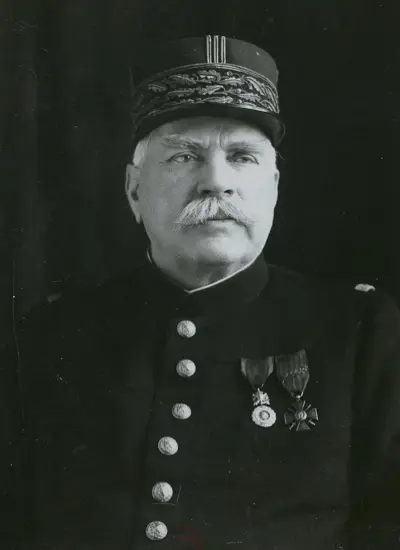
Joseph Jacques Césaire Joffre was a French general who served as Commander-in-Chief of French forces on the Western Front from the start of World War I until the end of 1916. He is best known for regrouping the retreating allied armies to defeat the Germans at the strategically decisive First Battle of the Marne in September 1914.
