Louisa Garrett Anderson Quotes
To remain single was thought a disgrace and at thirty an unmarried woman was called an old maid. After their parents died, what could they do, where could they go? If they had a brother, as unwanted and permanent guests, they might live in his house. Some had to maintain themselves and then, indeed, difficulty arose. The only paid occupation open to them a gentlewoman was to become a governess under despised conditions and a miserable salary. None of the professions were open to women; there were no women in Government offices; no secretarial work was done by them. Even nursing was disorganized and disreputable until Florence Nightingale Florence Nightingale recreated it as a profession by founding the Nightingale School of Nursing in 1860.
Louisa Garrett Anderson, 1873–1943, British Surgeon & Feminist, Description of the state of women of her mother’s generation in the 1850s and 1860s
Sourced by: Eigen's Political and Historical Quotations

Billinghurst was physically handicapped without the use of her legs. She protested and marched in protest parades using a hand propelled tricycle which the police sometimes dumped her out of and left her immobile in alleys.

See {628477} for the Dean’s answer. Professor Brooks was about to be married and under the mores of the day and Barnard’s rules, married women were not allowed to work. They should be at home taking care of husband and children. Ironically, there are still a few conservatives who advocate a return to the old policy.

See {628476} for the text that triggered this response. These quotations are very important because it illustrates the terrible sexism that existed even when women were hired into professional jobs which itself is rare. They should be at home taking care of husband and children. Ironically, there are still a few conservatives who advocate a return to the old policy.

Even today, her simple bluntness about such a sensitive subject is jarring. Imagine how it appeared in 1867 when this was a foreign idea which when broached by a woman, or even a man, was phrased delicately and discreetly. And yet, her phraseology was virtually impossible to argue against.


At the time and for the next decade she was one of the few world leaders who made women’s equality and rights a major priority. But slowly American and European women and many men began to give higher priority to using foreign policy and foreign aid. Then women from Asia and Africa began to take up the issue and in the early 21st century even some women in the Islamic nations began to fight for women’s rights. Mrs. Roosevelt. However, was the first modern major and high visibility politician to make women’s rights a major international and national issue.
She had been appointed by President Truman to be the US Delegate to the First United Nations sessions where she had a major role in forming the organization to meet the needs of the United States (The veto in the Security Council for example). John Foster Dulles, our Secretary of State was publically totally against having any woman in that position and later would come to regard Mrs. Roosevelt as a great danger. See {585211} . Yet he admitted that she did a good job with the UN. She was 62 at the time, and while we do not consider that as very old any longer, there were very few people who would be active in politics at that age and certainly no women. She stayed active however until her death more than a decade later.


He gave a litany of ills that have occurred when women had been educated. He did not provide any of the counter examples.

In English law, the second a woman married, she ceased to exist and an entity independent from her husband who had total control in the family. This doctrine was carried over to American law. See {629246}.


Jorge Mario Bergoglio


This question he asked of an interviewee was at the time not even considered offensive of patronizing and women and men who advocated careers for women would try to explain that women could do both. Very few would counter with the point that what about men and their “neglect” of family life or the reality that through the entire Second World War MILLIONS of women were working. This quotation illustrated the culture change in the years since then.

She made no public appearances other than being the hostess at state dinners. Nor did she ever give an interview or talk about any public matter. Contrast her view with that of her successor as first lady, Nellie Taft {640711}.

Puglia was an anti feminist. The stoa was the city square where men commonly congregated and discussed politicis.

Nixon did however make some minor appointments of females. One irony of this statement is of all the Presidents in American history, he was probably the most erratic and emotional.

SNCC had been formed to promote equality, but race and class were the issues, not gender. Many of the women left SNCC and proceeded separately to start a women’s movement.

Vladimir Lenin
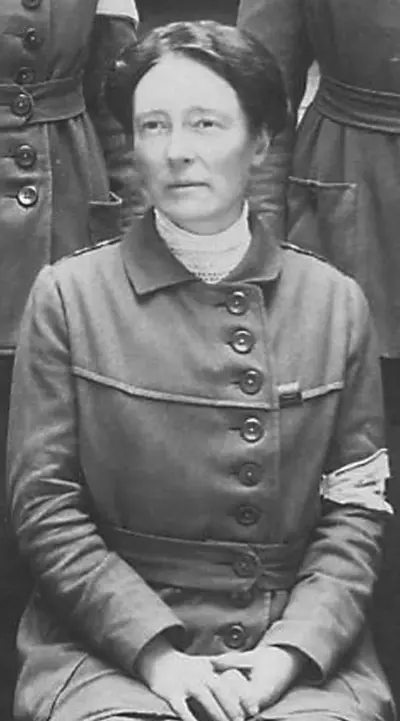
Louisa Garrett Anderson, CBE was a medical pioneer, a member of the Women's Social and Political Union, a suffragette, and social reformer. She was the daughter of the founding medical pioneer Elizabeth Garrett Anderson, whose biography she wrote in 1939.
