Hugo Black Quotes
To put a halt to what it considered to be a rising tide of concentration in American business, Congress, with full power to do so, decided to clamp down with vigor on mergers … on the premise that mergers do tend to accelerate concentration in an industry. Many believe that this assumption of Congress is wrong, and that the disappearance of small businesses with a correlative concentration of business in the hands of a few is bound to occur whether mergers are prohibited or not. But it is not for the courts to review the policy decision of Congress…
Hugo Black, 1886-1971, U. S. Senator (Democrat, AL), U. S. Supreme Court Justice, U. S. v. Pabst Brewing Co., 1966
Sourced by: Eigen's Political and Historical Quotations


See {641989} & {641989} for more on the Radio Channel corrupt giveaway.


Here, an officer of a large corporation (Pittsburgh Plate Glass) makes the classic argument of large corporations about the anti-trust laws which prevent them from using their economic power to crush competition. The claim that the large corporations are at a disadvantage and handicapped in competing with small companies is easily refuted by the bankruptcy rate of small businesses which is large, and that of large corporations which is very small, and that of major monopolies which is virtually zero.

Macdarland’s role was the equivalent of the Mayor of Washington DC. As an ally and apologist for McKinley, he felt that the President was doing the best he could to deal with the monopolies who were then keeping competitive capitalism from functioning properly. Vice President Theodore Roosevelt thought McKinley weak and vacillating especially on the “trusts”, and when he assumed the Presidency, he accomplished much more. TR however did not discover the Trust problem. As this quotation shows, there was general political awareness amongst the politicians of the day of the Trust/Monopoly problem in America. It was Roosevelt who did something about it to the distress of many of his own party leaders who had previously intimidated McKinley into inaction.

The President had decided to aggressively push for railroad regulation to end the rate rebate abuses that were used to support the monopolies like Standard Oil. In vintage Roosevelt tactics, he gave his first major speech on the subject in the setting and forum that would be most opposed to it. The Union League Club of Philadelphia in included the wealthiest men in the area where were most opposed to any Federal Regulation of anything. All the major railroad executives and stock owners and traders were also members. The President wanted to persuade the opponents to change their positions, and sometimes he did. He also was driven by his concept of sports and athletics so that the “opposition” should have “fair notice” for the contest ahead.


Hatch was the chairman of the Senate Judiciary Committee at the time.


Almost all are made by the legislative and executive branches.


A justification of some mergers that would lessen competition was that the consumer would not be harmed as the merger will produce cost savings that could be passed on to the consumers. However, others argued that if the competition were reduced there would be no pressure on the merged companies to pass any savings along to the consumer. However, in this opinion, Justice Douglas set forth a basic principle of regulatory law: Even though the merger might have some consumer benefits, that is still no justification for doing.
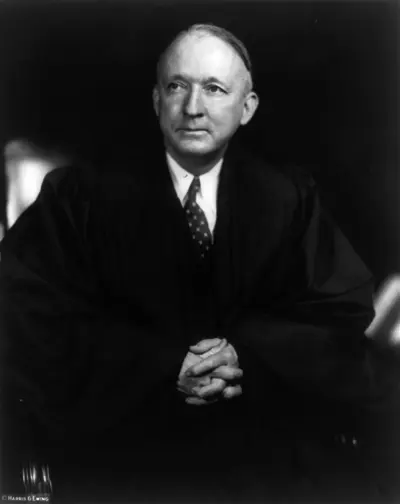
Hugo Lafayette Black was an American lawyer, politician, and jurist who served as a U.S. Senator from 1927 to 1937 and as an Associate Justice of the Supreme Court of the United States from 1937 to 1971. A member of the Democratic Party and a devoted New Dealer, Black endorsed Franklin D. Roosevelt in both the 1932 and 1936 presidential elections. Having gained a reputation in the Senate as a reformer, Black was nominated to the Supreme Court by President Roosevelt and confirmed by the Senate by a vote of 63 to 16 (six Democratic Senators and 10 Republican Senators voted against him). He was the first of nine Roosevelt appointees to the Court, and he outlasted all except for William O. Douglas.
