Adrian IV Quotes
Thou dost desire to enter into the island of Ireland, in order to subject the people to the laws and to extirpate the vices that have there taken root, and that thou art willing to pay an annual pension to St. Peter of one penny from every house, and to preserve the rights of the churches in that land inviolate and entire. We, therefore, … are well pleased that, for the enlargement of the bounds of the church. for the restraint of vice, for the correction of morals and the introduction of virtues, for the advancement of the Christian religion, thou shouldst enter that island, and carry out there the things that look to the honour of God and to its own salvation. And may the people of that land receive thee with honour, and venerate thee as their master;
Note the fact that the Vatican received a “fee” for in effect giving Ireland to Heny II. There are some people who doubt the authenticity of this particular bull. They argue that the English domination of Ireland was never sanctioned by the Church. Supporters of the authenticity however have the majority of the arguments. There are several Papal documents that refer to a Papal Bull sent to England’s king on the subject of Ireland. The “deal” with the cut for the church and the guarantee of church property was typical of deals made at the time. And there are copies of the bull that have been preserved (the original has never been found.)
Adrian IV, ~1100-1159, Roman Catholic Pope, Bull Granting English King Henry II the Right to Invade and Control Ireland, 1155
Sourced by: Eigen's Political and Historical Quotations

There are some who question the authenticity of this Bull. However, its existence was supported by John of Salisbury who claimed to be the emissary who arranged the Bull. See {611696}. However, those who are shocked that the Pope could have been so crass as to “give” a country to Henry II for money have claimed that the writing of John was also a forgery,
He was the only English Pope. This was the authority that enabled English King Henry II to invade Ireland. Many historians consider it the beginning of the problems between the Ireland and England which persists to this day. See {610520}. Some scholars think that this bull was a forgery stating that the writing style was different from other bulls of Adrian IV. Opponents believe that a change in secretaries could easily have accounted for the difference.

In effect, the English Parliament replaced the Pope as head of the Catholic church in Ireland with King Henry the VIII. He had already become the head of the Church in England when the Pope refused to grant him the right of divorce so that he could marry Anne Boleyn, The Irish clergy and many Irishman were aghast. They were instructed to erase the Pope from their literature {639436}. They were even more distressed when the English Royal Commission recommended the closing of all Irish monasteries. See {639434}.
He was the only English Pope. The act of invasion had been sanctified earlier in Adrian’s Papal Bull. See {610518}. Henry’s invasion was successful but the occupation and reform was a disaster which has ramifications to this day.

See {610517} for the Papal Bull which “gave” Ireland to England. There has been some dispute over whether this was a forgery to support the authenticity of the Papal Bull which itself was questioned.

This quotation shows the unique relationship that the Irish Republic has had with the Catholic Church. There was probably no other non Muslim country in the world where a political leaders could get elected avowing this kind of loyalty and control by a religious heirerchy. See {639726} for an even more Irish, drastic departure from the concept of separation of church and state.

Juan Lopez de Vivero. This document was a written declaration of sovereignty and war, read by Spanish military forces to assert their sovereignty (a dominating control ) over the Americas and their peoples. He issued it on “behalf of the King, Don Fernando, and of Doña Juana I, his daughter, Queen of Castille. and León”. It was read to the native peoples of the New World in Spanish which they did not understand and then were held to it on penalty of death thereafter. It was the legal and philosophical foundation for the worst example of colonial abuse in history.

Jorge Mario Bergoglio

This was before the state had officially sanctioned and accepted the church. Most of the institutions were pagan and the kings had subjects of both religions with Christianity not yet dominant. Yet among Christians, the Church had government temporal power, even before the church was allied with the state.

3rd Earl Russell of Kingston

Samuel Langhorne Clemens, 1835-1910

Of all the Western Colonial Powers, Spain was the worst. They took the most from their possessions and contributed the least. Worst, they killed off almost all the indigenous people.

Much of the Catholic Church was greatly influenced by Aquinas long past his death. This quotation laid the foundation for the view, that anything the Church does, even if seemingly wrong or absurd, has some positive value. Here, Aquinas refused to totally condemn the Church practice of giving indulgences (official absolution for serious sins) to the rich in exchange for money. His view assumes that there must be some good in all acts of the church, even if we can not now determine it. This view makes reform very difficult even after the evil is recognized. Some theologians argue that although this perpetuates some bad practices, it provides stability and prevents leaders of the church from constantly trying to adapt the church to meet current popular or civil criticism.

The Roman Catholic Church then maintained that salvation was dependent upon obedience to the Pope in all things civil and religious. See {595166} for the way that the Church at the time allowed some authority to civil authorities.


Much of the then prevailing opinion was the opposite—that men and women should be taught these things from birth and education. Right and God’s plan, they argue, need not be contested for with temptation and wrong or worse, the word of Satan.


King Henry VIII had left the Roman Catholic church and taken England and Ireland out also. He replaced the Pope as the head of the English and Irish churches. There was much opposition in Ireland and the priests were the most assertive opponents to the change and were still loyal to the Pope. Queen Elizabeth continued to have problems with the Priests. James I, Elizabeth’s successor, became fed up by the Roman Catholic Priests and therefor issued this Proclamation.

He had broken formation in the 1588 Great Armada defeat by England and was ordered onboard another ship of officers to be disciplined (scapegoats for the defeat). His ship was severely damaged, blown off course, and wrecked on the Irish coast. Note that he refers to the Irish as “savages” which was in comportment with the English perception of the Irish at the time—see {639438}. When shipwrecked the Irish robbed and stripped the Spaniards of every shred of their clothing, but they did not kill the few Spaniards who were left alive. They lived off roots and plants until they ran into other Irish who saw them as allied Catholics against the hated English. These Irish assisted them from being captured by the English and helped the escape back to Spain in a small boat.
The King had earlier replaced the Pope as the head of the English church. The references to money referred to a then common corruption of the Church whereby people could buy indulgences—religious papal pardons of past or future sins. This was a major revenue source for the Vatican and a major issue for Martin Luther and the Protestant Reformers some of who saw the pope as the Devil incarnate See {623153}. For Martin Luther’s view pf the practice and {626720}, {595195}, and {639436} for other contemporary views.

This is an excellent example of the many public insults that the Irish religious leaders hurled at each other exacerbating the intercommunal tension between the Catholics and Protestants. There were amost no Irish leaders of either religion who tried to dampen the animosity and conflict.


Professor Clark wrote this historical description of witchcraft and the Inquisition in contemporary verbiage as we would discuss the solution to serious problems of today. His overall point is that when society fears something, it establishes and institution to cope with the object of the fear, and the institution itself creates more fear as this is the way it “succeeds.” A more recent historical example was when Congress created House and Senate Committees to cope with the problem of communists infiltrating and undermining our important institutions. This had not been a problem until Senator Joseph McCarthy and a few others claimed that they had found thousands in our military, state department and other government agencies. In the final analysis, while there were NO witches, there were only a few former communists in government and most were fiction and imagination. Yet society went through a Red Scare that in some ways paralleled society’s problem with witchcraft.
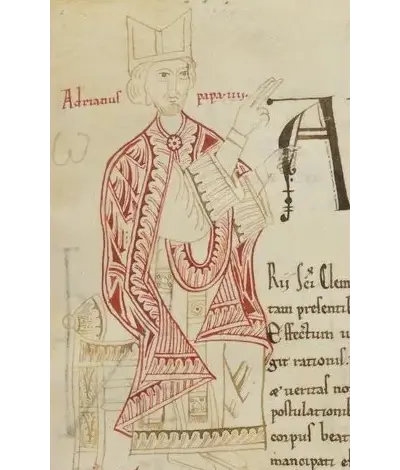
Pope Adrian IV, was head of the Catholic Church and ruler of the Papal States from 4 December 1154 to his death in 1159. He is the only Englishman to have been pope.
