Robert M. Gates Quotes
This is a time in which the sort of criticism of the President we are hearing troubles me. It shouldn’t be that speaking with one American voice, in a time of crisis, these days seems like a quaint idea.
Many of the leading Republicans viciously attacked President Barack Obama’s character, ability, and motives during the Ukraine-Russia Crisis. The irony if the attacks on the President is that un general the Republicans agreed with the actual policies and statements of the President on his dealing with the crisis but they were vicious in describing his as “Weak”, “Feckless”, “Not to be feared or taken seriously”. They wanted the President to be even tougher than he was and yet they told the world and the Russian leaders that he was “weak and could be pushed around,” thus undermining the President’s credibility and his likely success in implementing the tactics they wanted.
Robert M. Gates, U. S. Secretary of Defense (Republican, Director of the CIA, Telephone call with David Ignatius, Quoted on CNN News, March 5, 2014
Sourced by: Eigen's Political and Historical Quotations


This principle of support of Administration foreign policy (even if opposed) when abroad had an enormous influence on both political parties behavior for almost half a century. It began to fall apart with the hyperpartisanship that the Republican’s deep enmity to Democratic President Bill Clinton, and this was retaliated against be some Democrats during the George W. Bush Presidency. It completely disintegrated with the antipathy many very conservative Republicans had against President Barack Obama in the early 21st century. See {633113} for the Senator’s elaboration on the meaning of the policy.

The historian was comparing Obama to other historical presidents who either had a majority of both Houses of Congress or had an opposition party that was generally quite cooperative and willing to compromise for the sake of running the country smoothly. At this point in time there was a Tea Party wing of the Republican that was particularly negative and obstructionist. They tended to threaten and intimidate the main stream Republicans who used the filibuster to block legislation the majority of Senators had voted for more times than all the other Congresses in American history. And that was only in Obamas first 6 years.

War had broken out in Europe and Jefferson enumerated a series of actions so that the United States would remain neutral. He was concerned that individual Americans would partake in foreign wars and then be captures of have to be ransomed or would give offence to some other nation who would assume that the American was acting with government approval and was allied with an enemy. The issue of American mercenaries fighting in foreign conflicts has been controversial ever since.


The nation was facing the scourge of McCarthyism. Senator Smith was the most courageous member of the Senate in denouncing the lying demagogue of her own party who was so powerful at the time—Joseph R. McCarthy. At the same time, there were some communists trying to undermine the values or the nation as well as the fascists. Smith was one of the first to recognize the danger of both.


Not only were the Democratic and Republican Parties at odds, but both political parties were split with the different factions very hostile to each other. The Populists and the Progressives were putting great pressure in the Democrats, and the Corporate Republicans strongly and often viscously opposed President Roosevelt. America was politically fractionated. Roosevelt called for a comity and unity which never took place.


This principle has been promoted by almost every party and government in every democracy—and even in totalitarian nations, that had an aggressive foreign policy that and had domestic critics. By eliminating internal debate of the foreign policy or war policy, the government accomplishes two objectives. Foreign enemies, rivals and even friends perceive that the nation is much more united on the policies than it really is, and the administration does not have to spend time and effort fending off critics or opponents domestically. The price, as every nation has discovered, is not only more intense and sometimes violent opposition when things do not go right or as promised, but the nation tends to maintain a failed policy too long and does not change and minimize its damages. The Vietnam War in America was a classic example of both of these prices being paid dearly.

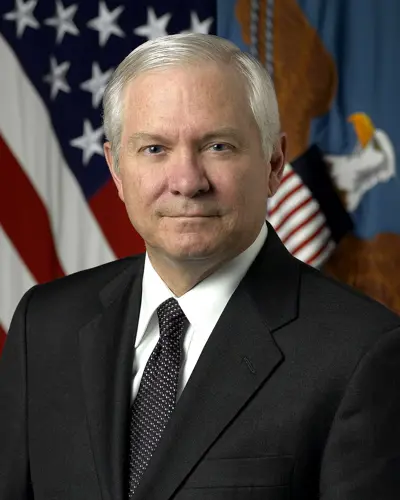
Robert Michael Gates is an American intelligence analyst, and university president who served as the 22nd United States secretary of defense from 2006 to 2011. He was originally appointed by President George W. Bush and was retained for service by President Barack Obama. Gates began his career serving as an officer in the United States Air Force but was quickly recruited by the Central Intelligence Agency (CIA). Gates served for 26 years in the CIA and the National Security Council, and was Director of Central Intelligence under President George H. W. Bush. After leaving the CIA, Gates became president of Texas A&M University and was a member of several corporate boards. Gates served as a member of the Iraq Study Group, the bipartisan commission co-chaired by James A. Baker III and Lee H. Hamilton, that studied the lessons of the Iraq War.
