Desiderius Erasmus Quotes
They may attack me with an army of six hundred syllogisms; and if I do not recant, they will proclaim me a heretic.
Erasmus, Desiderius. Praise of Folly. Translated by Betty Radice, Penguin Books, 1971, p. 162.


This quotation—presented in its entirety because it is so unbelievable—illustrates one of the uglier and nasty aspects of Colonial America. Most of us associate early American colonists with persecuted minorities escaping the intolerance of Europe, but so much of the concept of tolerance then concentrated on the rights of a religious community but provided little if any obligation to then be tolerant of OTHER minorities in their colonies and communities. In this case, Massachusetts Christians did not perceive Quakers as either Christians or another sect to be tolerated. They not only wanted the Quakers stopped from coming to other parts of America, but actually attempted to interdict the Quaker immigrant ship, capture the Quakers, and sell them into slavery in the Caribbean. What makes the incident even more offensive is that the ethics of this was never questioned and was even justified as Christian acts and even duty. The Welcome evaded the Porpoise The founding fathers knew about these incidents and the religious discrimination that was rampant in many Colonial communities as bad as England and Europe. Hence, the separation of Church and State concepts were not just protections against the way of the old world, but dealt with a clear and present danger that Colonial history had demonstrated.

As a result of Henry VIII establishing himself as the head of the Church in England and Ireland in place of the Pope, Henry’s heirs also became head of the Church. And that was the role that Queen Elisabeth had inherited in addition to the Crown. Many of those loyal to the Pope found most offensive the fact that a woman was making decisions for men and women on matters of faith. A Papal representative travelled with FitzGerald and probably helped him compose this document of which this is but 2 sentences. He may have drafted it completely. The Pope was a factor in many of the Irish rebellions against the English, and this caused great suspicion of all English Catholics whose loyalty to the Queen was in conflict with their loyalty to the Pope who was plotting for a Catholic takeover of England and Ireland.

1968 was one of the more polarized presidential elections, and most politicians in the heat of debate, tended to make ad hominem attacks on their opponents instead of rational arguments. Conservatives tended to attack opponents as communists, communist sympathizers, or giving aid and comfort to the communists. Often they never got around to attacking the real political position of their opponents. Buckley realized that he would not persuade many of his fellow conservatives to eschew the personal red-baiting on their opponents. Their political; base demanded this. But he urged them to restrain themselves and first make a rational attack on liberalism and liberal policies. Very few took his advice that year or ever in the remainder of the century until the fall of the Soviet Union.


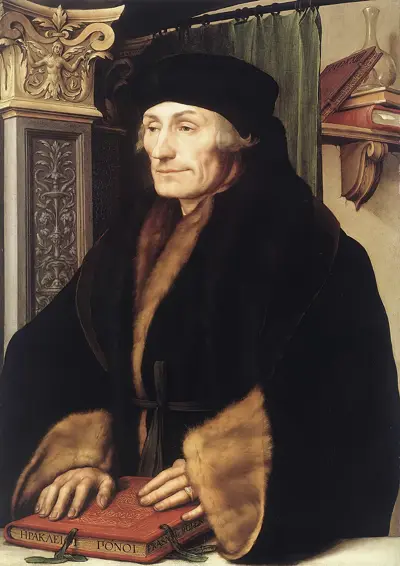
Desiderius Erasmus Roterodamus was a Dutch philosopher and Christian scholar who is widely considered to have been one of the greatest scholars of the northern Renaissance. As a Catholic priest, Erasmus was an important figure in classical scholarship who wrote in a pure Latin style. Among humanists he enjoyed the sobriquet "Prince of the Humanists", and has been called "the crowning glory of the Christian humanists". Using humanist techniques for working on texts, he prepared important new Latin and Greek editions of the New Testament, which raised questions that would be influential in the Protestant Reformation and Catholic Counter-Reformation. He also wrote On Free Will, In Praise of Folly, Handbook of a Christian Knight, On Civility in Children, Copia: Foundations of the Abundant Style, Julius Exclusus, and many other works.
