John Sherman Cooper Quotes
There was no testimony of conspiracy - Oswald's efforts to get in touch with the Soviets and with the Cuban Fair Play groups in New York were rebuffed, rebuffed at every step.
United States, Congress, House, Select Committee on Assassinations. Investigation of the Assassination of President John F. Kennedy: Hearings Before the Select Committee on Assassinations of the U.S. House of Representatives, Ninety-Fifth Congress, Second Session. Vol. 3, U.S. Government Printing Office, 1979.

During the Cold War and afterwards many Americans attributed the problems we were having with the Soviet Union emenated from the fact that they were Communists, and our focus was anti-communism. Kennen, however argued that it was not Communism that was the cause of the Aggression of the Soviet Union. It was an extension of the Russian Culture. After the Soviet Union collapsed, and Communism was rejected by the Russians, we still had a great deal of Russian aggression and Foreign Policy problems with Russia. Kennan was right. It was the Russian culture, history, values and traditions that were the primary cause of most of the problems with Russia.

who worked with the Communists. The Communists were to Flip-flop again when Russia needed arms and assistance to fight Hitler when the pact broke down. See {595773}


Actually the United States has a long history in interfering with foreign elections throughtout Latin American Countries, Europe, Asia,, and Africa. Russia also has been trying to tilt elections recently in Eastern Europe and befroe the COld War the International Communist Party was involved trying to swing elections since shortly after the Russin Revolution. Before that the Czars agents were involved in many foreign elections. But the United States and Russia historically are relative newcomers and rank amateurs in interering with foireign elections when compared with Germany and France and the Champion--Great Britain who controlled much of the world and very often promoting democratic values like elections throughtout the world and then workign to manipulate those elections. Japan and Chine did much less of this historically. Instead they just conquored other counties and placed their puppets in charge. What was new in teh 2016 Russian interference in the American Election was the fact that it was done by hacking computers. Putin had accused Hillary Clinton of Interfering with the Russian election when he last ran for President by funing Russian organziations that oppo

He finally had to. In the government of national reconciliation, the Fascists—called Conservatives after WWII—were led by Don Manuel and he took the second place while the Republicans with the majority had the Prime Ministership. The Communists were part of the Republican coalition as they had been in the Civil War.


at the end of World War I 1st Earl Lloyd-George of Dwyfor


This was only 6 years after the Russian Revolution. Communist Russia had extended its influence to much of the world without firing a shot. To many, communism looked like the future. The Russian inability to make communism work economically in the next 70 years destroyed most of its influence.

WWII had come while most of the world was still recovering from the Great Depression. Communists, the world over, were expecting a major revolution in America, Britain and most industrial nations. However, continuation of Theodore Roosevelt’s reforms, the Franklin Roosevelt’s New Deal, the strong American wartime economy, Eleanor Roosevelt’s human rights accomplishments at the UN, the Marshall Plan and Truman’s support of non-communist governments in Europe, and the Labor Party coming to power in Great Britain produced an atmosphere of progress and hope, which provided an alternative to a proletarian revolution and communism. The Cold War then was the only road for international communism.


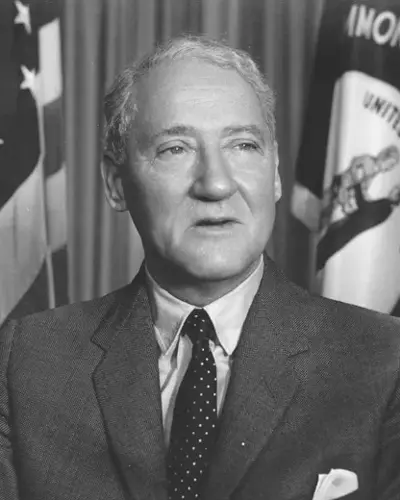
John Sherman Cooper was an American politician, jurist, and diplomat from the Commonwealth of Kentucky. He served three non-consecutive, partial terms in the United States Senate before being elected to two full terms in 1960 and 1966. He also served as U.S. Ambassador to India from 1955 to 1956 and U.S. Ambassador to East Germany from 1974 to 1976. He was the first Republican to be popularly elected to more than one term as a senator from Kentucky and, in both 1960 and 1966, he set records for the largest victory margin for a Kentucky senatorial candidate from either party.
