Nikita Khrushchev Quotes
I once said, 'We will bury you,' and I got into trouble with it. Of course we will not bury you with a shovel. Your own working class will bury you.
Khrushchev, Nikita. Speech in Split, Yugoslavia. 24 Aug. 1963. Reported in The New York Times, 25 Aug. 1963, p. 1.


The Red Scare had already reached most conservatives and Truman and most others had not yet been affected by the fear of Communism that so many people had through the 1970s.


Harriman at that time was the United States Ambassador to Russia and one of President Roosevelt’s closest advisers. There were those who claimed that the Roosevelt administration was very naïve about the potential danger of Stalin. This statement as well as others like it, show that the administration was not so naïve and ignorant.


The British suspected that the Turks of Anatolia were complicit with Bolshevism


Yale University had announced the discovery of a Norse map called the Vinland Map. It was an old Viking map that showed the East Coast of America and Canada as well as Greenland and Iceland. It purported to prove that the Vikings had been to America before Columbus. This was shocking and unbelievable to large numbers of Italian Americans many of whom lived in New York City. Most Italian Americans rejected the possibility that the map could be genuine, but there had to be a reason that it was forged. In the midst of the Cold War, there was an obvious villain and it did not take long before large numbers of people believed and repeated the headline. The quotation shows how rabid the anti-Communism of the Cold War was. The authenticity of the Vinland Map is still debated. Ironically, Columbus—the “discoverer” of America, never got to North America at all. He landed in and captured some islands in the Caribbean. The Daily News was then the largest circulation newspaper in the United States.


This was only 6 years after the Russian Revolution. Communist Russia had extended its influence to much of the world without firing a shot. To many, communism looked like the future. The Russian inability to make communism work economically in the next 70 years destroyed most of its influence.


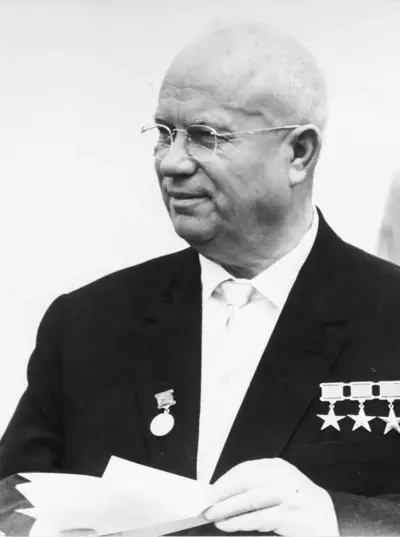
Nikita Sergeyevich Khrushchev led the Soviet Union as the First Secretary of the Communist Party of the Soviet Union from 1953 to 1964 and as chairman of the country's Council of Ministers from 1958 to 1964. During his rule, Khrushchev stunned the communist world with his denunciation of Stalin's crimes and began De-Stalinization. He sponsored the early Soviet space program, and enactment of relatively liberal reforms in domestic policy. After some false starts, and a near-nuclear war over Cuba, he conducted successful negotiations with the United States to reduce Cold War tensions. His proclivity toward recklessness led the Kremlin leadership to strip him from power, replacing him with Leonid Brezhnev as First Secretary and Alexei Kosygin as Premier.
