Ferenc David Quotes
There is no greater mindlessness and absurdity than to force conscience and the spirit with external power.
Ferenc David, 1510–1579, Founder of the Unitarian Church in Transylvania, Quoted in Michael McGee, "The Transylvania Journey
Sourced by: Eigen's Political and Historical Quotations


This quotation is important because it emphasizes an aspect of freedom of religion that is not usually discussed—the freedom to LEAVE a religion. As an Islamic reformer born in Iran, this notion is extremely important. Under Sharia—Islamic Law—capital punishment is required for anyone who converts from Islam to any other religion. This has been made a part of the civil law of many Islamic nations from Afghanistan to Saudi Arabia as well as Iran where Sharia IS the civil law. There is no other religion in the world which makes conversion away from the religion a capital crime requiring execution. Executing people who leave a religion is a major violation of the Universal Declaration of Human Rights.


Jews were forced to convert to Catholicism under penalty of death. While the archbishop did not approve, he did not describe the murders in moral terms or used his great religious power to stop the practice.


A portion of this quote can be found in the Jefferson Memorial in Washington, D.C.

John Witherspoon, a Presbyterian minister with evangelical sympathies, was one of the signers of the Declaration of Independence.
Jefferson wrote his friend that the New England clergy had opposed him because he would block their efforts to merge church and state. Inscribed in the rotunda of the Jefferson Memorial in Washington DC. The third sentence is often quoted without the first two.


The wording was rejected and the delegates insisted upon the original proposed language: “Well aware that Almighty God hath created the mind free …” This is a very important historical quotation because it shows that Henry and a few others wanted to make the society Christian centric, However, the majority insisted that it be non-sectarian. Many of the delegates rejecting the “Jesus Christ” language were themselves practicing Christians, but they were aware of the terrible religious wars and strife in Europe and between Christians and Muslims as well as the persecution of Jews, Quakers, and other sects; they did not want that in America so they rejected the idea of an established Christian Church or culture.


Quintus Septimius Florens Tertullianus


Prior to Vatican II, freedom of conscience was not explicit in Catholic Doctrine. The controlling view had been that of Pope Pius IX a hundred years earlier. See {612299}.
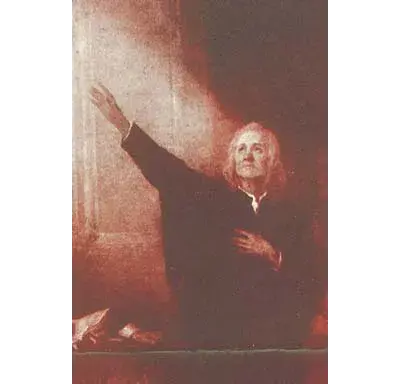
Ferenc Dávid was a Unitarian preacher from Transylvania, the founder of the Unitarian Church of Transylvania, and the leading figure of the Nontrinitarian movements during the Protestant Reformation.
