Arthur Henderson Quotes
The years of the economic depression have been years of political reaction, and that is why the economic crisis has generated a world peace crisis.
Henderson, Arthur. "Essential Elements of a Universal and Enduring Peace." Nobel Lecture, 11 Dec. 1934, Oslo. Nobel Lectures, Peace 1926-1950, edited by Frederick W. Haberman, Elsevier Publishing Company, 1972.


The “Great War” was a term then used for the First World War. He actually understated the effect on the generations. It affected more than two.


In 1921 when Harding took office, the nation was in the midst of a major depression which was to get worse before it got better.

Most people think that in a democracy, the government has more control over the economy than it really does as Hoover observed almost a century ago. However, the major issue between liberals and conservatives is whether or not the government should use the tools that it does have that might influence the economy and to what extent the government should ameliorate the damage that the poor and middle class suffers from the recession or depression. Unemployment insurance and food stamp distribution are basic examples of amelioration. When the Great Depression hit, Hoover was president and he chose not to use the powers of government and became America’s worst President at managing the economy.


His appeal was also in the name of concurring heads of state of Finland, Holland, Denmark, Norway, Luxemburg, and Sweden.


For his seditious activities he was sentenced to penal servitude for life. He escaped and came to America where he entered politics
since the end of WWI The railroads were nationalized for WWI and he ran them all as a government official


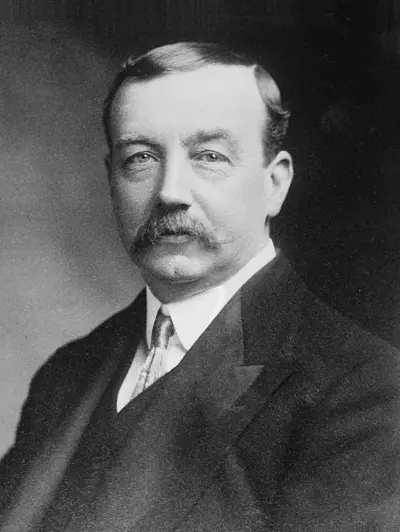
Arthur Henderson was a British iron moulder and Labour politician. He was the first Labour cabinet minister, won the Nobel Peace Prize in 1934 and, uniquely, served three separate terms as Leader of the Labour Party in three different decades. He was popular among his colleagues, who called him "Uncle Arthur" in acknowledgement of his integrity, his devotion to the cause and his imperturbability. He was a transitional figure whose policies were, at first, close to those of the Liberal Party. The trades unions rejected his emphasis on arbitration and conciliation, and thwarted his goal of unifying the Labour Party and the trade unions.
