Francis Hopkinson Quotes
The world looks toward us as a country that may become a great nursery of arts and sciences.
Francis Hopkinson, 1737-1791, Poet & Composer
Sourced by: Eigen's Political and Historical Quotations


L. P. Jacks. This lecture was given well before the development of the atomic bomb, after which many politicians and intellectual leaders picked up on this theme. Then each generation since has echoed it.


During this period—especially the first 500 years, the Islamic world was far ahead of the Christian intellectually and culturally. A university in Bagdad actually had women students as well as men. Ironically, the Muslims studied and preserved the ancient Greek and Roman science and literature while the West slipped into the Dark Ages. The Muslims developed science and the arts to new heights. However, around 1100 a religious orthodoxy began to take hold that saw new innovation of any kind as blasphemous. Intellectually, Islamic society began to decline while at the same time the Christian world was emerging from the dark ages. After the Protestant reformation, Christendom intellectually began to thrive while Islam continued in its anti-intellectual and intolerant mode which still prevents most Muslim nations from modernizing, Note that there was American intellectual interest in Islam towards the end if the 19th century,

Bethe was the head of the Theoretical Division of Los Alamos and was one of the Senior Scientists who developed the Atomic Bomb.
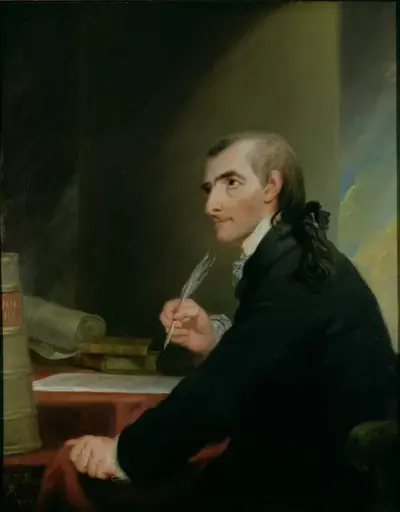
Francis Hopkinson was an author and composer. He designed Continental paper money, the first United States coin, and two early versions of the American flag, one for the United States and one for the United States Navy. He was also one of the signers of the Declaration of Independence in July 1776, as a delegate from New Jersey. He served in various roles in the early United States government including as a member of the Second Continental Congress and as a member of the Navy Board. He later became the first federal judge of the Eastern District Court of Pennsylvania on September 30, 1789.
