Benazir Bhutto Quotes
The three most beautiful words in the English language: We the people.
Benazir Bhutto, 1953-2007, Pakistani Prime Minister, Address to U. S. Congress, June 5, 1989
Sourced by: Eigen's Political and Historical Quotations


There is a certain redundancy in that “Fenian” means “Party.”

The view was considered so radical at the time that Fox's name was erased from the Privy Council.

See Franklin Delano Roosevelt and Grover Cleveland for a similar view.


Note the similarity to Lincoln who Ataturk very much admired.


_0_thumbnail_47x47.jpg "Statue of Robert Hall in Leicester.")
For many people the implication of this quotation is that there should be no government secrets withheld from the citizens who have the right to examine. Others argue that government may have temporary secrets to protect against foreign enemies for example, but that these must be declassified very promptly so that the citizens can examine the actions of their government in time to replace the government if they are not satisfied. Almost all government officials tend to reject the first implication out of hand, and grudgingly accept the second with their discretion controlling when declassification should take place. The problem of America is twofold. There is much over-classification (material kept secret that should not be at all), and the time till declassification is long in general and truly absurd in many cases. For example, there are documents from WWII that by 2013 had still not been declassified. See {591444}, {641317}, and {589105} for exemplar views. William Jennings Bryan introduced this principle into the American political dialogue. See {641027}.


The original draft presented to him had said “We the assembled delegates of ….” Morris made one of the most important and dramatic edits in the history of humanity. See {600144} for an idea of how determinative the phrase was years later.
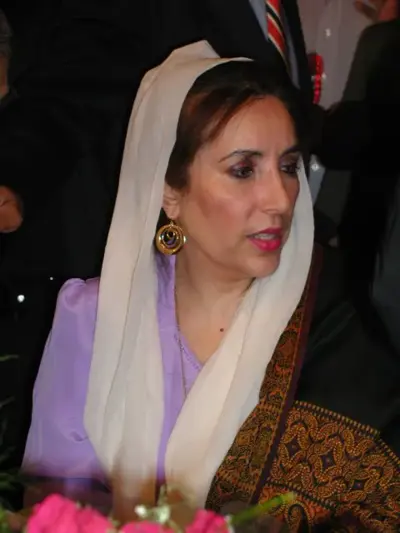
Benazir Bhutto was a Pakistani politician who served as Prime Minister of Pakistan from 1988 to 1990 and again from 1993 to 1996. She was the first woman to head a democratic government in a Muslim majority country. Ideologically a liberal and a secularist, she chaired or co-chaired the Pakistan Peoples Party (PPP) from the early 1980s until her assassination in 2007.
