Aga Khan IV Quotes
The temptation to inculcate rather than to educate is understandably strong among long frustrated populations. In many such places, public emotions fluctuate between bitter impatience and indifferent skepticism - and neither impatience nor indifference are favorable atmospheres for encouraging reasoned thought.
Islamic modernists like him are many among the educated Muslims but their views are often drowned out by the violence and extremist statements of the fundamentalists.
Aga Khan IV, Hereditary Imam. Shia Inami Ismali Muslims, “Global Education and the Developing World” The Peterson Lecture, Atlanta, Georgia, April 18, 2008
Sourced by: Eigen's Political and Historical Quotations

Ibn al-Nafis was one of the great scientists of all time. He analyzed the human heart, lungs, and circulatory system. This quotation is often given by Muslim modernists and reformers to illustrate that Islam at one time was open to new knowledge, dissent, ideas of all kinds. A century later, Islam closed intellectually and later and even today, Muslims are killed for what became heresy. Truth became determined by the Koran and the words of The Prophet only, Christianity and the Church imposed a similar restrictive view of truth using the Bible and Jesus. However, the Reformation and modernity led Christianity to merge and adopt the more modern and scientific view with the exception of some Christian fundamentalists. Islam had the modern view and abandoned it causing the many educated Islamic reformers and modernists of today great difficulty in changing the culture and laws as a whole.

She is a leading American Arab who is a Syrian expatriate.

Islamic modernists like Serageldin are many among the educated Muslims but their views are often drowned out by the violence and extremist statements of the fundamentalists.

Legal Religious Ruling. This is an example of a source of tension between some Muslims and others. Non-Muslims are required to have a Muslim Education in Muslim countries, but they insist that any required Christian or secular education in a non Muslim country is anti-Islamic.

This view is typical of most religiously educated Muslims and accounts in large part for the fact that the Islamic world is so scientifically backward—especially in the context of the great Islamic scientific development around 1000 AD. Religiously Islam closed and so did the entire outlook of the people, and the existing religious norm accounts for most of the backwardness of Islamic lands.

Jinnah’s vision was for a modern educational system and curriculum throughout Pakistan. He would not have recognized the religious madrassas that taught only the Koran and Islamic subjects that became so prevalent in Pakistan by the 21st century.


This quotation is fascinating but sad. In 1902, Aga Kahn III and other Muslim reformers gathered to improve the terrible state of Muslim education. Muslims could attend the English operated public schools which were excellent, but the Imams fought these schools as they were purely secular and not under their control. Yet the Madrassas religious schools that then existed taught by rote and only Islamic religious content—no mathematics, science, other literature, art or anything else. Much of the teaching was religiously extreme with not even modern religious content. Over a century later the Schools of Pakistan—the Islamic nation carved out of India and those of most of the Arab nations are little better and despite a century of progress, the curriculum is the same.

Even a cursory reading of the Koran and early Muslim history would show that there were vast inequalities in the economic order long before the ‘imperialists’ were involved in the Middle East. Throughout the Islamic world there has always been the oppressors and the oppressed and inequality has usually been much worse than in the ‘imperialist’ countries.
Al-Maarri’s quotations are not only meaningful in their own right, but they illustrate the openness and free thinking that was allowed in the early days of Islam before about 1100. If anyone wrote such things today in most Islamic countries he would at least be jailed if not executed for blasphemy. Al-Maari view of the unreliability of authority preceded Western philosophers like Spinoza by over 500 years. When the Jews and Christians, and the Muslims of the day, read Spinoza, they all excommunicated him. But al-Maari, in the intellectual flowing of Islam in Syria at the time was unmolested.

Traditional Islamic education of the time only dealt with the Koran but the skills of modern life, medicine, law, science were taught in the British secular schools, which Muslims generally would not attend. Kahn urged all is fellow Muslims to benefit from all forms of education.

Many of the Taliban leadership attended this Madrassa when young including Mullah Omar, the leader of the Taliban. Haq is often called “Father of the Taliban.”


It is precisely for these reasons that large numbers of Muslims consider Ghannouchi and other reformers to be threats to Islam and in need of suppression in order to protect their religion.

This is only one of many anti-American and anti-Israeli and anti-Semitic passages in the text. It is typical of much of the Wahhabi literature which also supports jihad and violence. Much of the funding for the Wahabbi comes from the Saudi Arabian Government and members of the Saudi Royal Family. There is total censorship in Saudi Arabia and nothing gets preached or printed if the Saudi government wishes otherwise. However, most of the imams in Saudi Arabia are Wahhabi and are paid by the government. The Royal Family’s only fear of losing power is if the Islamic clerics claim that the government is not supportive of Islam. They spend much money to buy their lack of opposition to the monarchy. The government position however is contrary to these hate-filled textbooks.

This principle, so important to the philosophy of science, was a major component of the philosophy of Spinoza—the part that had him excommunicated by the 3 major religions of the era.

He works were banned and he was banished by both the North Vietnamese and the South Vietnamese during the Vietnam War where he tried to be a mediator and was present at the Paris Peace Talks. As late as 2007 he was still not allowed into Vietnam.

The first Jewish Publication in the United States
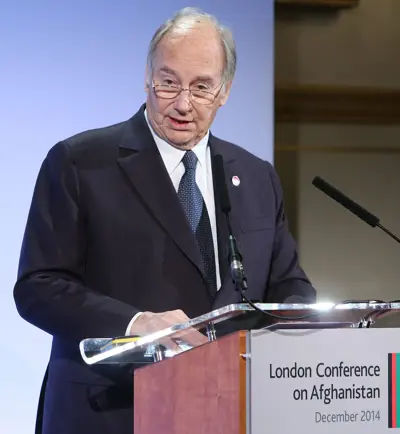
Prince Shāh Karim al-Husayni (شاه كريم الحسيني Shāh Karĩm al-Ḥussaynĩ), known by the religious title Mawlana Hazar Imam within Ismaili Muslim circles and as Aga Khan IV (آقا خان or آغا خان) elsewhere, is the 49th and current Imam of Nizari Ismailism, a denomination of Isma'ilism within Shia Islam. He has held this position of Imam since 11 July 1957, when, at the age of 20, he succeeded his grandfather, Sir Sultan Muhammad Shah Aga Khan III. Aga Khan claims to be a direct lineal descendant of the Islamic prophet Muhammad through Muhammad's cousin and son-in-law, Ali, considered Imam in Shia Islam, and Ali's wife Fatima, Muhammad's daughter from his first marriage.
