Jean-Jacques Rousseau Quotes
The strongest is never strong enough to always be the master unless he transforms strength into right…
Jean Jacques Rousseau, 1712-1778, French Philosopher, quoted by Elisabeth Zoller, “Bush Preemption Doctrine & the United Nations,” C-SPAN, April 3, 2004
Sourced by: Eigen's Political and Historical Quotations


This is the negative way of stating the Seneca quotation {642436}.


Robespierre was the driving force behind the Reign of Terror where hundreds of thousands of French citizens were beheaded because they were accused of not being loyal enough to the regime.


This was the group that decided who was to be executed in the Reign of Terror

This is an amazing speech which illustrated the best of the development and growth of Islam. Note that: The ruler who has just been given ALL secular AND religious power admits candidly that he may not be the best qualified. This would not happen for over another 1000 years and even today is very rare in any society. In addition, he invites the citizens to correct him when he is wrong. Later, Calihs would, like the Christian kings and popes claim infallibiity and kill any who suggested otherwise. And daring to correct the ruler was capital offence for most of history and is even dangerous in some Muslim countries today. Last and perhaps most amazing, the new Caliph called for an affirmative leveling of the inequality of rights and power and announces it asa one of his major responsiblities. It is this kind of vision so unheard of at the time which shows us why so many flocked to Islam at the time. From a fairness, human rights, and accoutabiity of the ruler point of view Islam was the most modern of the religions then. Tragically, other forces shaped Islam for the next 1500 years and most Muslim countries become the least modern and its rulers are least accountable to the citizenry with none of the other rights and concept of fairness that Abu Bakr and other early Islamic leaders brought.
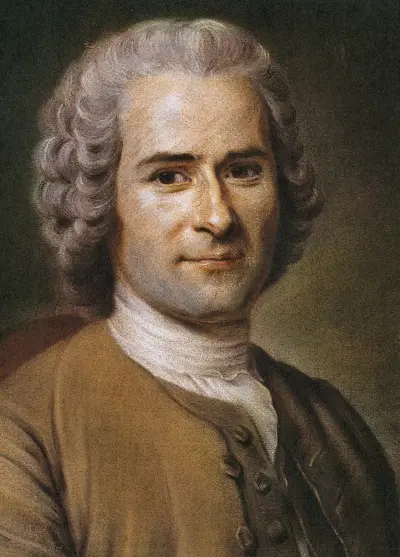
Jean-Jacques Rousseau was a Genevan philosopher, writer, and composer. His political philosophy influenced the progress of the Enlightenment throughout Europe, as well as aspects of the French Revolution and the development of modern political, economic and educational thought.
