Carol Moseley Braun Quotes
The really important victory of the civil rights movement was that it made racism unpopular, whereas a generation ago at the turn of the last century, you had to embrace racism to get elected to anything.
Moseley Braun, Carol. Interview with Tavis Smiley. The Tavis Smiley Show, NPR, 26 Feb. 2003.

Arkansas Governor Faubus ordered the national guard to prevent Black students from integrating Central High School in Little Rock. President Eisenhower was a man of action and not rhetoric and his lack of firm public statements overlooked an opportunity to use the Presidential “bully pulpit” and exercise his moral leadership and authority. Armstrong was irate at Eisenhower for appearing to do nothing and say nothing. See {615852}. When Eisenhower did enforce the court order and used Federal troops, Armstrong sent him this congratulatory telegram. His reference to walking into the schools was in support of many who suggested that the best thing the President could have done was to personally take one of the Black students by the hand and walk into the school with him or her. With the mood of the Southern racists, such an act was potentially very risky for the President and it is not known whether of not the President and his staff ever considered such an act.


Amazing as it is to most Americans today, the first time there was an interracial kiss depicted on television was on the Science Fiction TV Show Star Trek in the late 1960s. Although the public reaction was not as hostile as the television executives and politicians of the time feared, there were organized boycotts of NBC and many death threats to the actors, writers, producers and executives.


At the time, the Southern segregationists were all Democrats and they blocked any Democratic attempt to pass any Civil Rights legislation. When he could not get a Civil Rights commitment from his own party, Powell turned to the Republicans and the President wrote this letter. In return, in November, Powell endorsed and supported Eisenhower instead of Stevenson, his own party’s nominee. Eisenhower could not get any legislation on Civil Rights as the Southern Democrats would always block it. When President Lyndon Johnson finally forced the 1963 Civil Rights Act through the Congress, the racist Southern Democrats cut a deal with Goldwater and the conservative Republicans, and switched parties. Since then the Civil Rights stance of the two parties reversed. The Democrats were thereafter pro Civil Rights and the Republicans, the party of Lincoln and Reconstruction, thereafter reversed their Civil Rights position and opposed progress in this area.


The great contralto singer, Marian Anderson, an African American, had been refused by the Daughters of the American Revolution the use of Constitution Hall as a venue for her concert based on their White Performers Only policy. First Lady, Eleanor Roosevelt, resigned in protest from the DAR and she and the President asked Secretary Ickes to arrange a public concert at the Lincoln Memorial and he did. There was no Civil Rights Act at the time.


Grady, representing what he called the New South pole kindly of Blacks in the North (See Quotation 643652), but gave his highly racist views to his Southern brethren—see Quotation 643649. He overtly in the North advocated liberty and the right to vote for Blacks (more than most Southerners at the time, but wanted the Federal role limited so that the enforcement of Black liberty and the voting franchise to be left to the States. And that is what occurred for the next half century. However, the state governments not only did not provide liberty and the voting franchise, the Southern States passed legislation and opted policies allowing KKK and other terror and intimidation so that Blacks would not exercise their rights to vote and be free. It is had to tell whether he was naive enough to believe that the Souther States would do what he claimed in the North or whether he not only realized what was likely to happen with the states in charge, but presented a moderate picture deliberately to keep the Federal government from interfering with the prerogative of the states to discriminate against Blacks. His racist views in his Southern speeches (for example, see quotation 643649) lead many to believe the latter view.
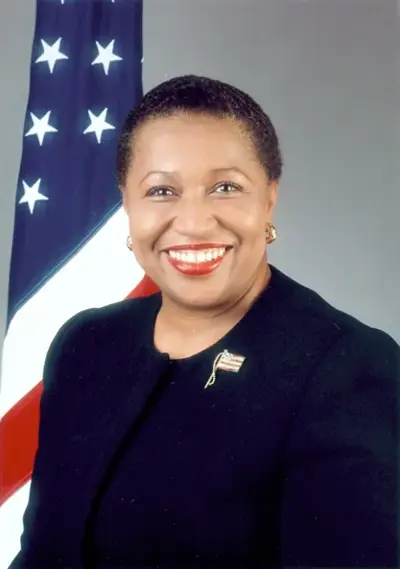
Carol Elizabeth Moseley Braun, also sometimes Moseley-Braun, is an American diplomat, politician and lawyer who represented Illinois in the United States Senate from 1993 to 1999. Prior to her Senate tenure, Moseley Braun was a member of the Illinois House of Representatives from 1979 to 1988 and served as Cook County Recorder of Deeds from 1988 to 1992. She was elected to the U.S. Senate in 1992 after defeating Senator Alan Dixon in a Democratic primary. Moseley Braun served one term in the Senate and was defeated by Republican Peter Fitzgerald in 1998.
