Thomas Friedman Quotes
The price of oil and the price of freedom always move in opposite directions in oil rich ‘petrolist’ states. The higher the average global crude oil prices rises, the more free speech, free press, free and fair elections, an independent judiciary, the rule of law, and independent political parties are eroded.
Thomas Friedman, Foreign Affairs Columnist & Journalist, “The First Law of Petropolitics”, Foreign Policy, May-June, 2006
Sourced by: Eigen's Political and Historical Quotations


The Center is in Holland. Chouket is Tunisian

Referring to the Erdogan government of Turkey. That country elected Erdogan who then turned his back on the Ataturk inspired democracy and instituted many non-democratic policies and practices including jailing civil servants, teachers and journalists who publicly criticize the president or the government.

His views are a mix of modernism and fundamentalism. He favors democracy and elections but also favored the Taliban destroying the great ancient Buddha statues when he was called an idol worshipper for urging the preservation of art.


Putin was the then Russian President. Corruption was rampant.

Referring to an Order-in-Council forbidding any discussions of the Canadian Cabinet's secret uranium deals:

He was commenting about Saudi Arabia, but oil wealth generally seems to harden nations to reform and change of all types.
If a state has substantial natural resources, the rulers and their close supporters can generate enough revenue for themselves without worrying about the industrialization of the nation, education, economic development which requires the health and education of the population. As a result, while “rentier” states seem rich, they very rarely improve the quality of life of most of their citizens.
Referring to the autocratic President of Turkey, Recep Tayyip Erdogan.


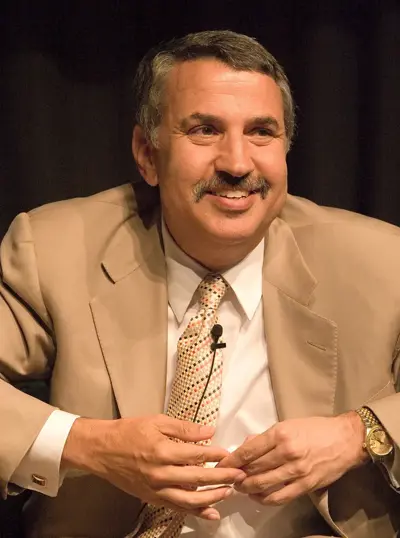
Thomas Loren Friedman is an American political commentator and author. He is a three-time Pulitzer Prize winner who is a weekly columnist for The New York Times. He has written extensively on foreign affairs, global trade, the Middle East, globalization, and environmental issues.
