John Marshall Quotes
The power to regulate commerce does not look to the principle by which boats were moved. That power was left to individual discretion. The act demonstrates the opinion of Congress that steamboats may be enrolled and licensed in common with vessels using sails. They are, of course, entitled to the same privileges and can no more be restrained from navigating waters and entering ports, which are free to such vessels, than if they were wafted on their voyage by the winds instead of being propelled by the agency of fire. The one element may be as legitimately used as the other, for every commercial purpose authorized by the laws of the river, and the act of a State inhibiting the use of either to any vessel, having a license under the act of Congress, comes, we think, in direct collision with that act. The acts of the Legislature of the State of New York, granting to Robert R. Livingston and Robert Fulton the exclusive navigation of all the waters within the jurisdiction of that State, with boats moved by fire or steam, for a term of years, are repugnant to that clause of the constitution of the United States, which authorizes Congress to regulate commerce, so far as the said acts prohibit vessels licensed, according to the laws of the United States, for carrying on the coasting trade, from navigating the said waters by means of fire or steam.
While many use the invention and development of the Steamboat as an example of breakthrough technology by private enterprise, the reality was that Fulton and Livingston could not raise the private capital to develop the vessels and start operating them until the State government stepped in and granted them a monopoly for 20 years in the waters of the entire state of New York including the Hudson River and New York Harbor. This was one of the first examples of “corporate welfare” and subsidies for development of new technology. Fulton’s company used the courts to enjoin anyone else from operating a steamboat, and Fulton could charge very high rates as he had no competition thanks to New York State. Other boat operators then went to New Jersey which passed its own allowing anyone stopped by NY courts to sue Fulton & Livingston for triple damages. The lower Hudson River and New York Harbor was on the shores of BOTH states and each had an equal claim to jurisdiction. The Supreme Court settled the dispute in one of the major legal cases in American history. See {624486}
John Marshall, 1755-1835, Chief Justice of the U. S. Supreme Court, U. S. Congressman (Federalist, VA), U. S. Secretary of War, U. S. Secretary of State, Gibbons v. Ogden, 1824
Sourced by: Eigen's Political and Historical Quotations

While many use the invention and development of the Steamboat as an example of breakthrough technology by private enterprise, the reality was that Fulton and Livingston could not raise the private capital to develop the vessels and start operating them until the State government stepped in and granted them a monopoly for 20 years in the waters of the entire state of New York including the Hudson River and New York Harbor. This was one of the first examples of “corporate welfare” and subsidies for development of new technology. Fulton’s company used the courts to enjoin anyone else from operating a steamboat, and Fulton could charge very high rates as he had no competition thanks to New York State. Other boat operators then went to New Jersey which passed its own allowing anyone stopped by NY courts to sue Fulton & Livingston for triple damages. The lower Hudson River and New York Harbor was on the shores of BOTH states and each had an equal claim to jurisdiction. The Supreme Court settled the dispute in one of the major legal cases in American history. See {624485}


Fulton issued permits and seized boats that operated without their endorsement. A steamboat operator, Thomas Gibbons, had received a permit from the Federal Government to operate steamboat service between New York City and the New Jersey Shore. Fulton and New York would not let him traverse Hudson Bay and land in New York. This set the stage for the most important Supreme Court Case on Interstate Commerce--Gibbons v. Ogden (1824). See {621351}.


The notion of government subsidies to private companies that performed valuable pubic services—public-private partnerships was used extensively by Clinton and was one of reasons that New York developed faster than the other Colonies. At the formation of America, Virginia and Pennsylvania were much bigger and wealthier states than New York. In large part, Clinton led the rapid growth and development.


Cummings was arguing against a Constitutional amendment. His alternative led to Roosevelt's court packing schema.


The view that the Supreme Court was the final arbiter of constitutional controversies was not held in early America.

The steamboat was one of the first examples of American preeminence in technology. Like the airplane and the computer to come later, it’s importance was generally not recognized early.


The major issue was whether Congress and the Federal Government could make laws and regulate the communities of people who had settled in the new territories. The argument that Young made was that unless a power was specifically enumerated in the Constitution as being granted to the Federal Government it was not. Most Constitutional scholars believe that there were powers implied by the enumerated powers such as the right for the Federal Government to regulate child labor or the safety of nuclear power plants which of course were never mentioned in the Constitution. At the same time anti Mormon sentiment led many to extend Federal Regulation to Mormons that had not been extended to other people. Plural marriage was one of those major value issues. The Mormons were very innovative in setting up institutions like buying cooperatives and systems for medical care and welfare, and many of these threatened the then established economic principles of many men of power and wealth. See {614881} for Brigham Young’s similar view.


This criticism of business has been made ever since by many opposed to protectionism, corporate welfare, subsidies, and bailouts. Yet they get bigger each decade.

Most Americans agreed with this policy upon which Cleveland had run, but it was not favored by the companies that had been benefitting from monopolies, protective tariffs, corporate subsidies and corporate welfare, and government largess. Ironically, at the time, large American business was generally opposed to free trade and were supported by the Republican Party. The Democrats wanted free trade—just the opposite of the beginning of the 21st century.
This quote is interesting because it itemizes some of the things that Jefferson clearly felt was beyond the constitutional powers of the Federal government. Yet all of these things were done by the Federal government after Jefferson passed away. The Corps of Engineers commonly builds and /or maintain rivers and canals, the military does some of its own manufacturing even today but far less than in the first half of the 20th century when much of the munitions were made in government factories. The federal government has and does maintain special farms. Some opponents of big government point to this quotation to illustrate how we have deviated from the concepts of the Founding Fathers.

Essentially, this case prohibited state courts and judges from interfering with Federal officials doing their duty within a state.
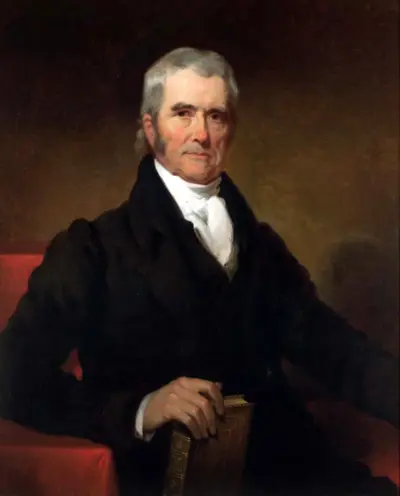
- Born: September 24, 1755
- Died: July 6, 1835
- Nationality: American
- Profession: Judge
John Marshall was an American politician and lawyer who served as the fourth Chief Justice of the United States from 1801 to 1835. Marshall remains the longest-serving chief justice and fourth-longest serving justice in Supreme Court history, and he is widely regarded as one of the most influential justices to ever sit on the Supreme Court. Prior to joining the Supreme Court (and for one month simultaneous to his tenure as Chief Justice), Marshall served as the United States Secretary of State under President John Adams.
