Moshe Dayan Quotes
The only method that proved effective, not justified or moral but effective, is when Arabs plant mines on our side. If we try to search for the [particular] Arab [who planted mines], it has no value. But if we harass the nearby village ... then the population there comes out against the [infiltrators] ... and the Egyptian Government and the Transjordanian Government are [driven] to prevent such incidents, because their prestige is assailed ... the method of collective punishment so far has proved effective.
Moshe Dayan, 1915-1981, Chief of Staff, Israel Defense Forces, Israeli Defense Minister (Labor), Quoted in Benny Morris, Righteous Victims : A History of the Zionist-Arab Conflict, 1881-1999
Sourced by: Eigen's Political and Historical Quotations

The culture of Iraq and the Desert tribes made raiding and looting of other villages or travelers or caravans a way of life. The British occupiers were determined to put an end to it and Harris, a young officer, developed the retaliation of bombing the village of the raiders and their warlords. This appears to be the beginning of destroying of houses in the Middle East as a method of retaliation and punishment which would be adopted so well by the Israelis as a humane method and they often quoted Harris saying: “we put them to the maximum amount of inconvenience, without physical hurt, and they soon stopped their raiding and looting.”

This view has had a profound influence on the attitudes and actions of many Israelis in dealing with Arab terrorism. “Proportionate” retaliation is only retaliation and perhaps vengeance, but this doctrine developed out of frustration that little else worked has in many subsequent occasions driven Israeli government defense policy. The Lebanese War of 2006 was perhaps the best illustration.


It was speeches like this which created a distrust of the Palestinian intentions when there were negotiations of land for peace. Worry that peace was just a pretext for war or takeover, inhibited many Israelis from wanting to give up anything unless they could get a more reliable partner. The Palestinians had a traditional fertility rate that was several times that of the Israelis.
”Palestine” to the Arabs of the area meant the territory of the West Bank, Gaza, and Israel itself. They wanted to expel the Jews and or take over the whole area as a single state—Palestine—with an Arab majority. With the Israeli Defense Forces successes under Dayan, this notion of Palestine was “finished”. The notion of a Palestinian State which included the West Bank and Gaza but not Israel was then negotiated and these negotiations were ongoing for years. Minorities of Arabs and Israelis did not want to see a any Palestinian state that did not include Israel proper, and they blocked it whenever they could.

He grossly underestimated the intensity of the American patriotic feeling and the fighting ability of the Colonists. He Commanded the Royal Marines at the Battle of Bunker Hill where he was killed by a shot fired by ex-slave and Black Patriot, Peter Salem. Note the recommendation to destroy towns. At the time, that was considered improper in warfare between nations, yet it was not so clear in fighting a rebellion. However, this was against British policy and it was not a tactic employed in trying to suppress the American Revolution.

The UN peacekeepers have had a sorry record of protecting people from aggression, attacks and even genocide. In Sarajevo they stood by as the Serbs rounded up 7,000 male Muslims and marched them off to be executed right past the United Nations forces. And the UN was unable to stop the genocide in Rwanda. In the Middle East on several occasions, Arab armies have walked right through the United Nations peacekeepers and attacked Israeli civilians. So no one, lease of all the Israelis have any confidence that the United Nations can provide security in Jerusalem or anywhere else in the Middle East. The Israeli position was that when the Jordanians controlled the city, they did not allow Jews to their sacred places to pray or have access to the city. The UN could not prevent violence at all. No one else is willing, but since 1967 the Israelis have maintained the peace and security of the city while allowing the Arabs and other groups access to their places of worship.

The Minister equates the unintended consequences of war and civilian casualties with a terrorist retaliation which has as its purpose the killing of as many civilians as possible. The proliferation of terrorism complicated the ethics of counter terrorism. In the case of Palestinian terrorists their tactics included using civilian facilities---schools, hospitals, homes---from which to launch rocket attacks or to store weapons or hide terrorists. Under international laws of war, a civilian facility and the civilians in it become legitimate military targets the minute that weapons are stored in or fired from that location or that location is used for planning, training, equipping or manufacturing of military material. Palestinian terrorists claim that even though civilians were harmed in legitimate, legal attacks on military targets, a proper response is to send suicide bombers into civilian areas and preparing the explosives with nails and rat poison to cause as much pain as possible.


Just before the Six Day War. Syria did take the initiative and provoked the war which the Arabs lost badly. Ironically, Egypt and Jordan, pushed into the war by Syria, lost the most in manpower and territory.


A large part of the Middle East and the now “Arab” states used to be a very large Jewish State. Jews had lived in the Palestinian area and expanded from there, also using conquest as all other nations had and even occasionally, forced conversion, to establish the Jewish State. This was destroyed by the Romans and the Jews have not had a state until 1948 when the UN voted to create Israel.
David Ben-Gurion was the Zionist leader in Palestine and became the first Israeli Prime Minister. In 1948 the United Nations Partitioned Palestine into two states, one Jewish and one Arab. But over a dozen Arab Armies invaded the Jewish area to take it by force. They were repulsed by a much smaller, poorer armed, Zionist population of desperate Jews. In some areas Palestinian Arabs at the request of the outside Arab leaders attacked their Jewish neighbors and where they did or they had helped the Arab armies, the civilian population was ejected. Arab leaders and demagogues told Arab Civilians to go to the West Bank behind the front lines so that the Arab armor could advance unimpeded. They were told that they could return the following week after the victory. When the victory never came, the Israelis would not allow the Arabs to return and this was the origin of the Refugee problem. About the only thing that the Jewish and Arab leadership agreed upon was that the Arab civilian population should leave the front and go to the West Bank.

Dagestan was the poorest of the Soviet States, It was then mainly populated by feuding Muslim sects who were in constant conflict with each other and an Islamic nationalist group that wanted independence from Russia. There were also a large number of bandits in what was a frontier culture of banditry and lawlessness.


In addition to facing regular Confederate Troops, there were irregular insurgents who would fire at and harass normal civilian activity much like the terrorists in the Mideast today. Like today, the insurgents could exist only as long as they were sheltered and assisted by the Southern civilian population. Sherman did not see this as collective punishment as all the people in the small town of Randolph were helping the insurgents.

Hamas, a terrorist organization controlling Gaza at that time had fired a thousand missiles into Israel. To stop them, the Israeli Defense Force using air power destroyed hundreds of Hamas facilities and homes of Hamas leaders. They also killed many Hamas terrorists, but at the same time there were also civilian casualties including women and children. Some critics of Israel formulated a moral equivalence between the two sides especially since the Israeli’s had anti-missile defense that exploded most of the missiles in flight. The Israeli Prime Minister explained the moral and ethical distinction. The Israeli’s did not strike any building without warning; they always notified the population in advance as to which target would be hit—something that no other nation had ever done in an armed conflict. However, Hamas forced many civilians to remain in the targeted buildings and almost all of the civilian casualties were to the civilians who Hamas decided to sacrifice. The facilities attacked were all places where Hamas had stored weapons or were command and control facilities, or were used for planning terrorist activities or were the residences of Hamas fighters of high rank. All these are legitimate targets under the rules of war, and the military force that uses them are responsible for clearing the civilians out. In this case, the kept them in, and in many cases sent them in, so that the Israeli military forces would be accused of injuring or killing innocent civilians.

This quotation is of historical significance because it is a source, in addition to the Bible, about the fact that the kingdom of Israel existed and was in conflict with the Moabites. Politically it is important currently because a few of the modern Arab leaders have claimed that there was never a Jewish Kingdom in the region and therefore the Jews do not have a claim on any of the land of Palestine. This is strong evidence that they are wrong. Omri was the 6th King of Israel and his son, Ahab, the 7th. A stele is an ancient stone with writing carved on it. The picture is of the Mesha Stele which today is in the Louvre Museum in Paris.

The “adversary” was Pakistan, which was frequently sending military and terrorist attacks into Kashmire much if which has been disputed by Pakistan ever since the Partition of India in 1949. India had a very disciplined and well led military and like most sophisticated military powers did not immediately retaliate for military incursions despite the public pressure to do so. Instead they gave themselves time to plan and organize the logistics for a series of surgical strikes at the terrorist and/or military concentrations Pakistan had deployed close to the border which they launched several days later.


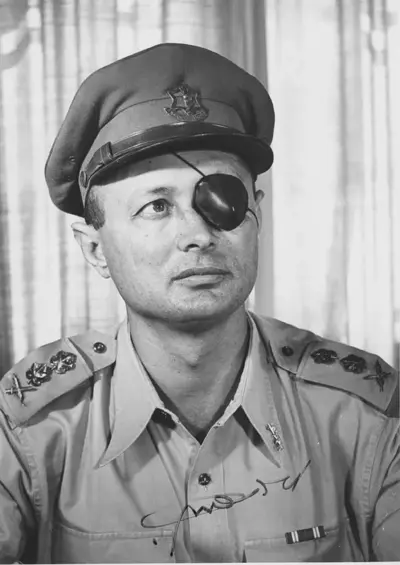
Moshe Dayan was an Israeli military leader and politician. As commander of the Jerusalem front in the 1948 Arab–Israeli War, Chief of Staff of the Israel Defense Forces (1953–1958) during the 1956 Suez Crisis, but mainly as Defense Minister during the Six-Day War in 1967, he became a worldwide fighting symbol of the new state of Israel. In the 1930s, Dayan joined the Haganah, the pre-state Jewish defense force of Mandatory Palestine. He served in the Special Night Squads under Orde Wingate during the Arab revolt in Palestine and later lost an eye in a raid on Vichy forces in Lebanon during World War II. Dayan was close to David Ben-Gurion and joined him in leaving the Mapai party and setting up the Rafi party in 1965 with Shimon Peres. Dayan became Defence Minister just before the 1967 Six-Day War. After the Yom Kippur War of 1973, during which Dayan served as Defense Minister, he was blamed for the lack of preparedness; after some time he resigned. In 1977, following the election of Menachem Begin as Prime Minister, Dayan was expelled from the Labor Party because he joined the Likud-led government as Foreign Minister, playing an important part in negotiating the peace treaty between Egypt and Israel.
