Mesha Quotes
Omri, king of Israel, has oppressed Moab many days…. His son succeeded him and he too said, “I will oppress Moab”.
This quotation is of historical significance because it is a source, in addition to the Bible, about the fact that the kingdom of Israel existed and was in conflict with the Moabites. Politically it is important currently because a few of the modern Arab leaders have claimed that there was never a Jewish Kingdom in the region and therefore the Jews do not have a claim on any of the land of Palestine. This is strong evidence that they are wrong. Omri was the 6th King of Israel and his son, Ahab, the 7th. A stele is an ancient stone with writing carved on it. The picture is of the Mesha Stele which today is in the Louvre Museum in Paris.
Mesha, 9th century BC, King of Moab (Kingdom in part of Modern Jordan), “Mesha Stele”, 9th century BC
Sourced by: Eigen's Political and Historical Quotations


This was one of the most accurate foreign policy assessments ever made. The next year the first Arab-Israeli war began when the state of Israel came into being. See {624566} for another accurate prediction.


The president believes that Israel was created solely to atone for the Holocaust. He has suggested that Israel should be in Europe. He does not mention the fact that that most of the Middle East including Israel, Palestine, Syria, Jordan, Lebanon, and others where part of a Jewish Kingdom over 2000 years ago and Jews were in the Holy Land ever since. He also does not consider the fact that Arab leaders were allies of the Nazis and supported the Holocaust.

When the United Nations partitioned Palestine into a Jewish and a Palestinian State the Arab Countries all jointly militarily attacked the fledgling Jewish State of Israel. Despite the Israeli’s being overwhelmingly outnumbered they beat back the invaders. However while many Arabs stayed on their Israeli land and some helped the Jews defend against the Arab Armies, some others abandoned their homes and land and went to neighboring Arab Counties. This is what they had been asked to do by the Arab governments who wanted to be able to militarily attack communities without worrying about killing Arabs. To spur the evacuation the Arab leadership spread false propaganda about Israeli atrocities and frightened them into leaving. As a motivation to leave they were told that they could move into the Jewish lands and property when the Jews had been driven out. To make matters worse, some Israeli radicals repeated the lies to induce the Arabs to abandon their lands. In at least one case, Arabs who stayed were subjected to Jewish violence. Each side has since railed about what the other side did at that point in time and each fails to mention how they contributed to the refugee problem.

Mohamed Anwar El-Sedat

The Arab armies of Egypt, Syria, Jordan and the PLO were preparing a coordinated attack on Israel. After statements like this, the Israeli’s preempted the attack, routed the Egyptian Airforce and Army, and then defeated the other three. The Arab “War of Liberation” resulted in the Arabs losing more with Israel tripling it’s control of area. The quotation however cast a pall over attempts thereafter to create a Palestinian State as in effect the PLO had announced a policy of a Holocaust—the extermination of the Israelis. The dispute over land was not for the Jewish state a land negotiation amenable to compromise and give and take, but instead was an existential threat to Israel whereby any compromise might result in the death of the entire population. As the ultimate intention of the PLO had been revealed.

This statement hardened the Israeli population away from anything that would bring Hamas more power. The PLO leader had, for ALL the Palestinian people, recognized the right of Israel to exist {633062}. The Israelis observe that this is a de facto declaration of war, and hence treat Gaza and Hamas as an enemy force to be reckoned with. See {635341} for another alarming reneging of the recognition of Israel.

”Palestine” to the Arabs of the area meant the territory of the West Bank, Gaza, and Israel itself. They wanted to expel the Jews and or take over the whole area as a single state—Palestine—with an Arab majority. With the Israeli Defense Forces successes under Dayan, this notion of Palestine was “finished”. The notion of a Palestinian State which included the West Bank and Gaza but not Israel was then negotiated and these negotiations were ongoing for years. Minorities of Arabs and Israelis did not want to see a any Palestinian state that did not include Israel proper, and they blocked it whenever they could.


The very day of Israel’s birth, 14 Arab Armies attacked a badly outnumbered group of citizens with no formal army and few weapons. The reason the Mufti called on Arabs to leave was to allow the Arab heavy armor and artillery to be used without endangering Arab civilians. The Jews however had no place to go and were fighting for their very lives. Surprising the entire world, they not only beat back all the Arab Armies but won additional strategic positions. The Arabs who stayed became Israeli citizens and there are almost ½ million of them today. Those that left, were rejected by the Arab nations who started the war (except Jordan) and asked them to leave could not be distinguished from those Arabs who, even after the Israeli victory vowed to attack again. That is the origin of the Arab refugees. Since the other Arab states except Jordan would not assist their fellow Arabs, the only solution seems to be a Palestinian State on the West Bank and Gaza, but for that to happen war and terrorism would have to end and Israel would have to be accepted.


This view has had a profound influence on the attitudes and actions of many Israelis in dealing with Arab terrorism. “Proportionate” retaliation is only retaliation and perhaps vengeance, but this doctrine developed out of frustration that little else worked has in many subsequent occasions driven Israeli government defense policy. The Lebanese War of 2006 was perhaps the best illustration.

Lev Davidovich Bronstein. There was even extensive Arab hostility to the Jews in Palestine before WWII and the Holocaust. Apologists for the Arab violence to the Jews have pointed to the creation of the state of Israel, the Arabs defeat in the wars with Israel and the fact that many Palestinians left their homes and could not return as the anger which fed the conflict. But as this quote shows they were attacking the Jews even before the second world war and the so called “reasons” for their violence.


Israel had again been attacked by Arab armies and at the same time the parties were in peace negotiations. Some argued that there should be a cease fire while negotiations were ongoing, but Rabin explained that if the two did not go on simultaneously and independently, neither might go well.
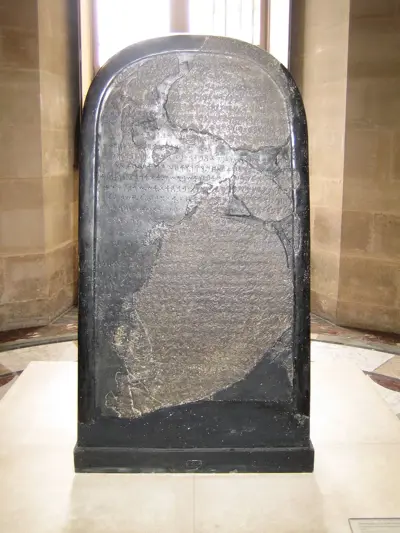
King Mesha of Moab was a king of Moab in the 9th century BC, known most famously for having the Mesha Stele inscribed and erected at Dibon. In this inscription he calls himself "Mesha, son of Kemosh, the king of Moab, the Dibonite."
