John Quincy Adams Quotes
The object of taxation is to raise a revenue for discharging the debts and defraying the expenses of the community, its operation should be adapted as much as possible to suit the burden with equal hand upon all in proportion with their ability of bearing it without oppression.
This is one of the first American Presidential statements citing the virtue of progressive taxation. What was an oppressive tax for one person might not be for another.
John Quincy Adams1767-1848, 6th President of the United States (Independent, MA), State of the Union Address, Washington, DC, December 2, 1828
Sourced by: Eigen's Political and Historical Quotations

whether or not to buy luxuries This quotation and {639885} together illustrate why it is so difficult to classify historical politicians in the left-right categories of a future time. Here Gogel seems a strong liberal arguing for progressive taxation and luxury taxes, and tax relief for the poop, while in {639885} he sounds like a 21st century extreme conservative.


This is opposite to the view that the power to tax is the power to destroy. See Oliver Wendell Holmes {603715}, Daniel Webster {37299} and John Marshall {320000}.


Opposing the ratification of the United States Constitution: Left before it ended.


Throughout most of the world, the rich and the aristocrats have been able to reduce or eliminate their tax obligations with the burden falling more heavily on the common people. Progressive taxation was thought to be a solution, but even in the United States by the 21st century many huge corporations paid little or no taxes while there was a heavy tax burden on small companies. Rich people generally paid a smaller percentage of their income than middle class people.

Comment made in the Congressional Congress debates in 1787. This precedes individual taxation. In the debate, Wilson felt state taxation “should accord with the number of freemen” as “it is strange that annexing the name of ‘State’ to ten thousand men, should give them an equal right with forty thousand.”
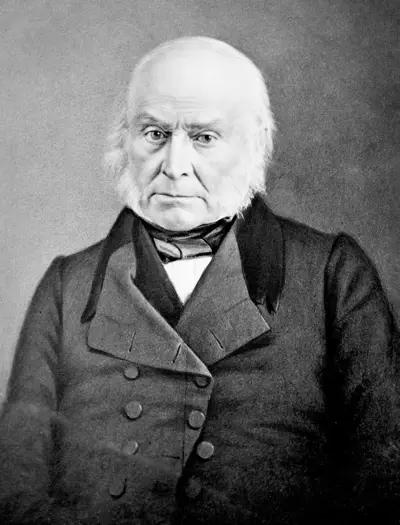
John Quincy Adams was an American statesman, diplomat, lawyer, and diarist who served as the sixth president of the United States, from 1825 to 1829. He previously served as the eighth United States Secretary of State from 1817 to 1825. During his long diplomatic and political career, Adams also served as an ambassador, and as a member of the United States Senate and House of Representatives representing Massachusetts. He was the eldest son of John Adams, who served as the second U.S. president from 1797 to 1801, and First Lady Abigail Adams. Initially a Federalist like his father, he won election to the presidency as a member of the Democratic-Republican Party, and in the mid-1830s became affiliated with the Whig Party.
