Ron Paul Quotes
The income tax is the most regressive tax imaginable, allowing government to take first claim on our lives. The income tax assumes government owns us, as individuals, and has a sovereign claim to the fruits of our labor.
Ronald E. Paul, U.S. Congressman (Republican, TX), Libertarian Nominee for President, Press Conference, April 28, 1999
Sourced by: Eigen's Political and Historical Quotations

whether or not to buy luxuries This quotation and {639885} together illustrate why it is so difficult to classify historical politicians in the left-right categories of a future time. Here Gogel seems a strong liberal arguing for progressive taxation and luxury taxes, and tax relief for the poop, while in {639885} he sounds like a 21st century extreme conservative.


This law established a fundamental principle that allowed capital to be invested in new and needy territories without running the risk of the locals discriminating against businesses or establishments owned by strangers. Many states and communities still find ways to favor local businesses but not be discriminatory taxation.


Opposing the ratification of the United States Constitution: Left before it ended.


This is opposite to the view that the power to tax is the power to destroy. See Oliver Wendell Holmes {603715}, Daniel Webster {37299} and John Marshall {320000}.


This is one of the first American Presidential statements citing the virtue of progressive taxation. What was an oppressive tax for one person might not be for another.


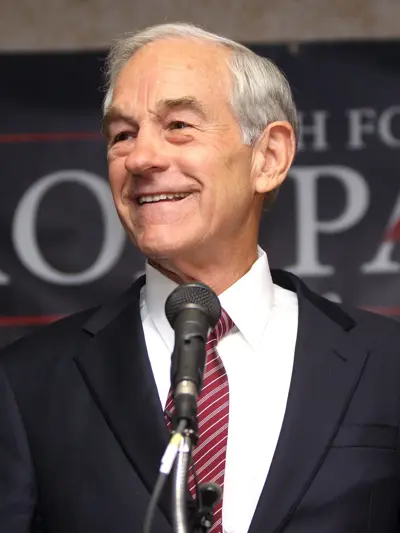
Ronald Ernest Paul is an American author, physician, and retired politician who served as the U.S. Representative for Texas's 22nd congressional district from 1976 to 1977 and again from 1979 to 1985, and for Texas's 14th congressional district from 1997 to 2013. On three occasions, he sought the presidency of the United States: as the Libertarian Party nominee in 1988 and as a candidate for the Republican Party in 2008 and 2012. A self-described constitutionalist, Paul is a critic of the federal government's fiscal policies, especially the existence of the Federal Reserve and the tax policy, as well as the military–industrial complex, the war on drugs, and the war on terror. He has also been a vocal critic of mass surveillance policies such as the USA PATRIOT Act and the NSA surveillance programs. He was the first chairman of the conservative PAC Citizens for a Sound Economy, a free-market group focused on limited government, and has been characterized as the "intellectual godfather" of the Tea Party movement, a fiscally conservative political movement that is largely against most matters of interventionism.
