Marcus Tullius Cicero Quotes
The name of peace is sweet, and the thing itself is beneficial, but there is a great difference between peace and servitude. Peace is freedom in tranquillity, servitude is the worst of all evils, to be resisted not only by war, but even by death.
Cicero, Marcus Tullius. Philippics. Translated by Walter C. A. Ker, Harvard University Press, 1926, p. 177.


The critic observed that the South would not give up their slaves voluntarily and that and that vigorous abolition pressure on the South would lead to war and asked Angelina if she would want a civil war. Grimke’s response was predictive of what happened—the most terrible was in U. S. History to end the most terrible cruelty and persecution in American history. Note that she herself was willing to die to end slavery. See {629094}.

See Joseph Addison which may have been the inspiration for this famous quote: {613374}.


This line was used in the WPA Federal Theater Project. The play was closed down, because the State Department was distressed that the Federal Theater quoting heads of State might be insulting to the world leaders. Mussolini was another character in the play and he was depicted as the boorish thug that he turned out to be. It was that which offended the government officials who closed the show before it could open. FDR used a similar line 6 years later. See {32529} . Dolores Ibarruri in the Spanish Civil War is quoted with a similar phrase at about the same time. See {604321}

This audacious general and Queen of one of the Roman Provinces conquered most of the area including Egypt. Then she declared her independence from the Roman Empire itself. A master of multilateral coalition leading, she was able to attract nearby provinces to join her. The Roman Emperor Aurelian himself set out to subjugate Zenobia—the Roman, Latin name. In the first battle, the Romans won a tactical victory for some territory but lost many men. The Emperor asked Bat Zabbai to surrender, but she refused in this famous reply. She was counting on the fact that the Romans would not accept the high losses she was inflicting. See Aurelian’s letter to the Roman Senate {606345}. The Romans did however did pay the price and eventually conquered Bat Zabbai and brought her to Rome as a captive. However she was very much admired by Roman society and after she pledged to not revolt against Rome, she was allowed to live in Rome—but not go back to Syria where she might raise another army. She became a major celebrity of Roman society and married a Roman Senator. Her exploits although well known at the time lapsed into obscurity in that later Roman Christian society did not see her as a fitting Christian female example, and when Islam developed in Syria, she was not considered a model Muslim woman. So a key figure in Roman history was ignored by most of the cultures until recently where the original documentation of the time has been made more widely available.


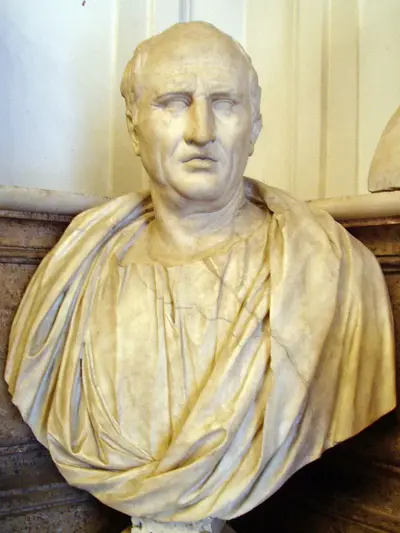
Marcus Tullius Cicero was a Roman statesman, orator, lawyer and philosopher, who served as consul in the year 63 BC. He came from a wealthy municipal family of the Roman equestrian order, and is considered one of Rome's greatest orators and prose stylists.
