John N. Bahcall Quotes
The most important discoveries will provide answers to questions that we do not yet know how to ask and will concern objects we have not yet imagined.
This quotation illustrates a difficulty that scientists have in trying to justify public funds in the context of a government program where specific objectives and timetables are wanted by the appropriators and public support needs to be developed.
John N. Bahcall, 1934-2005, Natural Scientist & Astronomer, President of the American Physical Society and the American Astronomical Society, Responding to journalist’s question on the use of the Hubble Space Telescope
Sourced by: Eigen's Political and Historical Quotations

Some scientists would use this as an example of what scientific research is really like; others would argue that Ballard, however great as a field scientists and explorer, was a poor basic scientist and theoretician. He tends to work in the softer side of his science. This would be a very unusual occurrence for an experimental physicist or a molecular biologist.

Sir Humphry was a religious man, and yet he focused on one of the great differences between science and religion. The latter is presumed true and eternal by its faithful, while science is never such. No truth is eternal in science and rarely does a scientific “truth” last 100 years without modification, elaboration or additional complexity. This is one of the reasons that scientists make poor witnesses at Congressional hearings. They are never certain of anything if they are good scientists. Witnesses from other fields testify with much more certainty as they are motivated by self interest or ideology where doubt is unacceptable.

This quotation illustrates a way in which science is frequently at odds with politics. Our politicians realize the importance of scientific research to our standard of living, economy, and quality of life. So they want to support research and development programs. However, budgeting and planning for these in terms of expected or desired results is virtually impossible. So scientific research, especially basic research is not susceptible to the usual planning and monitoring that is so common and effective in construction projects or other applications of science and technology. It is hard to predict when and which scientists will have the next critical idea. It is very difficult to hold scientists or administrators accountable for scientific research results because of this factor. See {624876}.


This statement as with others like it offended the religious authorities of the time as they claimed that they—-The Bible---knew everything important just as fundamentalist Muslims claim today about the Koran. So statements of this kind were considered heresy by some and still are.


This is one of the reasons that scientific research pays such large dividends to society.

It is not only the companies of rich nations that equip their people, but also the non-profit sector including the universities.


See related quote for another scientist with a first discovery.
Dr. Snyder was the youngest physicist at Los Alamos working on the Atom Bomb Manhattan Project. James Alfred Van Allen (1914–2006) had theoretically predicted that there was a “belt” of small rocks and pebbles around the solar system in a particular orbit but his hypothesis could not be confirmed because the rocks of the belt would be too small to be detected by the telescopes and sensors of the time. Snyder, at the Jet Propulsion Laboratory, was the head of a team that launched a rocket into the stratosphere whose sensors could detect much smaller objects than ever before because there was no interference from the Earth’s atmosphere. The sensor signals were radioed back to Snyder’s computers which produced thousands of pages of wide paper, line printer output which then had to be read and deciphered. Snyder took them home to start the deciphering process. Snyder’s wife Marjorie, had been used to helping with the mathematical process. At 2 AM, with the print outs spread on their living room floor, they “saw” the many small objects exactly where Van Allen predicted they would be. After savoring the fact that they knew something that no one else in the world knew, they called Professor Van Allen who was delighted to be awakened with the news. See related quote for another example of a scientist who made a unique discovery.


It was not very long before there was no scientific field any longer in which any human being could learn everything that is known. Sherrington was one of the first to see that coming.


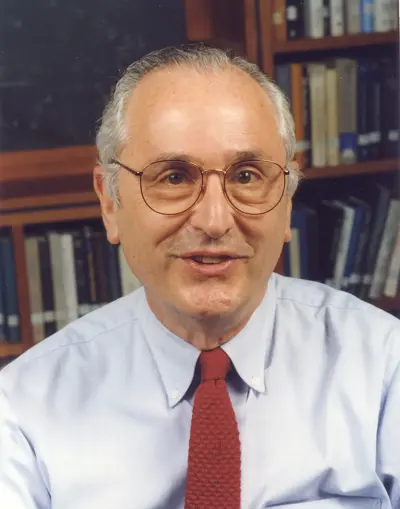
John Norris Bahcall was an American astrophysicist, best known for his contributions to the solar neutrino problem, the development of the Hubble Space Telescope and for his leadership and development of the Institute for Advanced Study in Princeton.
