William Smyth Quotes
The ministers and people of England might neither mean to be, nor be, the tyrants and oppressors which they were thought by the people of America, but whether they were as reasonable and prudent, or even as well justified in their measures of taxation, much less of coercion, as they supposed, is quite another question.
Ministers refers to the Government Ministers, not to clergy.
William Smyth, 1765–1849, English Historian, Comment on the English perspective on the American Revolution., Lectures on Modern History, published 1854
Sourced by: Eigen's Political and Historical Quotations

Earlier, his father had also castigated the ministers over their inept hard-line handling of the American Revolution. See {641505} .

At the beginning of the dispute between America and England, the issue was the raising of internal American taxes by Parliament without any American representation in Parliament. The issue escalated and when the British began using force, independence then became the American objective.

This is the same man who introduced the Stamp Act 12 years before which started the whole problem in America. See {74956}.

See {641497} for a quote from the Grenville speech. Fox, a conservative on most issues was an absolute radical on the issue of America. To aggravate the hawks in parliament, he used to dress in the colors of George Washington’s uniform to show his support once the war broke out.

Burke was one of the many members of the English Parliament who were opposed to a hard line in America in the beginning of the American Revolution and favored withdrawal after the hostilities began. The hard liners won un England and America was lost.
The did not listen to Pitt or others counseling moderation and ignoring the American acts of protest. Instead, the hawks sent armed troops and war broke out in earnest and the American Revolution reached the point of no return. Lord Chatham was furious at the incompetent handling of the situation by the government and he let them know it—see {641505} .


Ramsay was discussing the events leading up to the American Revolution. He and many English historians believe that had the British repealed a few if the hated taxes and given America some representation in Parliament, the conflict could easily have been avoided. Ramsay was the first major historian of the American Revolution.

Lee at that time was one of the leaders of the American colonists’ cause. He was born in England and was an old friend of Burgoyne who had just arrived in America. Lee wanted to explain the American viewpoint. Lee later became the senior major general under Washington.

The New England Restraining Act 1st Marquess of Bath
The Parliament was debating the reaction to the Stamp Act by the American Colonies. One of the members, reflecting a majority view, asked sarcastically when the American Colonies had been emancipated so that they could make their own independent decisions. Pitt then hit this one out of the park by reversing the question.
Hopkins was complaining about the fact that England could tax the colonies and thereby take their property without their consent made the American colonists in the “miserable condition of slaves.” Essentially the fundamental complaint of the Americans was this and in a decade it would erupt as the American Revolution. At the same time, Hopkins was a slave owner and yet saw nothing wrong with that.

Some of the Patriots of Early America realized that the oppressions of British rule were coming from Parliament and initially took the position that only the King could make laws for the colonies and not Parliament. Therefore, they were as Englishmen challenging illegal English laws. Most American hostility was directed at Parliament and not the King. However, once there was any physical resistance, King George came down with such a heavy hand that American hatred transferred to him. For related quotes on the King/Parliament issue, see {639145}, {639144}, {639142}, {639141}, {639140}, & {639137}

This was one of the first and is considered the best of the Colonial writings against taxation without representation. Despite this, Dulany is not well known in American history because when the Revolution finally came he was a loyalist.
It was repealed the next year, but much damage had been done to the relationship between the American Colonists and the mother country. It set the tone for American transition to a desire for independence. . Fox, a conservative on most issues was an absolute radical on the issue of America. To aggravate the hawks in parliament, he used to dress in the colors of George Washington’s uniform to show his support once the war broke out.
This was one of the first and is considered the best of the Colonial writings against taxation without representation. Despite this, Dulany is not well known in American history because when the Revolution finally came he was a loyalist.
At that time, Russia and Germany were autocracy, and the ruler could simply take the English money and force the soldiers to fight in a war they had not stake in nor understood.

The message was conveyed by the Secretary of State, Sir George Calvert (Lord Baltimore). Parliament and the British King were jockeying for position in their relative powers. King James took the position that Parliament could NOT make laws that affected the American Colonies. Parliament disagreed. Later, some of the American patriots would use this quotation to claim that they were only subject to the King and not to Parliament. For related quotes on the King/Parliament issue, see {639144}, {639143}, {639142}, {639141}, {639140}, & {639137}


This resolution of independence was voted upon a month before the Declaration of Independence. It was approved by 12 of the colonies but not by New York. The Congress appointed a committee to draft what became the Declaration of Independence and that was approved by all the colonies. The resolution was introduced by Richard Henry Lee on instructions from Virginia. The graphic is of Lee’s original notes.
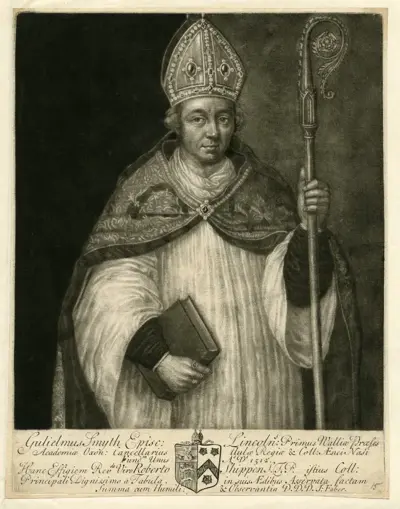
William Smyth (or Smith) was Bishop of Coventry and Lichfield from 1493 to 1496 and then Bishop of Lincoln until his death. He held political offices, the most important being Lord President of the Council of Wales and the Marches. He became very wealthy and was a benefactor of a number of institutions. He was a co-founder of Brasenose College, Oxford and endowed a grammar school in the village of his birth in Lancashire.
