Henry Clay Quotes
The measure of the wealth of a nation is indicated by the measure of its protection of its industry; the measure of the poverty of a nation is marked by the degree in which it neglects and abandons the care of its own industry, leaving it exposed to the action of foreign powers.
Clay, Henry. "In Defense of the American System." The Life and Speeches of the Hon. Henry Clay. Compiled by Daniel Mallory, Vol. 2, Robert P. Bixby & Co., 1843, p. 15.


This same argument was used before and since to justify protecting domestic manufacturing from foreign competition until it can mature sufficiently to compete in a global economy. One difficulty occurs if protective tariffs are imposed for this reason. The manufacturers protected never seem to reach the point where they can compete without the subsidy.


In October 2025 (ahead of ongoing trade negotiations), the Ontario Provincial Government (Canadian) produced a video ad distributed in the US using a voice-over of the above quote from a 1987 Ronald Reagan Presidential Radio Address. The ad uses five complete sentences from the five-minute weekly address, but they are spliced together out of sequence. Also, while the ad implies Reagan was against tariffs, it omitted the context that he was using the radio address to announce new tariffs imposed on Japan by his administration but that they should be seen as an unavoidable exception to his basic belief in free trade as the key to prosperity. He said, “our commitment to free trade is also a commitment to fair trade.” President Trump accused the Ontario government of producing a fraudulent ad and of attempting to influence the US Supreme Court as it prepares to hear arguments about the legality of Trump’s tariffs. As a result, the Trump administration terminated trade negotiations with Canada.

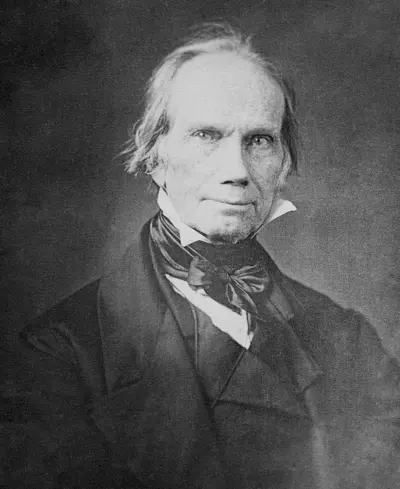
Henry Clay Sr. was an American attorney and statesman who represented Kentucky in both the Senate and House. He was the seventh House Speaker and the ninth Secretary of State. He received electoral votes for president in the 1824, 1832, and 1844 presidential elections. He also helped found both the National Republican Party and the Whig Party. For his role in defusing sectional crises, he earned the appellation of the "Great Compromiser" and was part of the "Great Triumvirate".
