Tariq Ramadan Quotes
The logic of freedom of religion implies freedom to be an atheist, even though, from a historical perspective, this has not been accepted in the Muslim world.
Ramadan, Tariq. Radical Reform: Islamic Ethics and Liberation. Oxford University Press, 2009, p. 158.


This is a critical quotation on the government establishment of religion issue. There are a few people who have argued over the years that the Founding Fathers and their culture was religious and where they were careful to avoid favoring one religion over another, they did NOT intend to put atheism on the same equal plane as religion as far as government action is concerned. However, some of the Founding Fathers were atheists, and some others like John Adams were deists—they believed in a God but not in the Trinity or in Judaism or any organized religion. So this quotation makes it clear that the First Amendment does NOT favor religion over non religion or secularism. Atheism must be on an equal footing but not on a higher plane.

Bush was trying to obtain the Republican Presidential Nomination and that party had come under the influence of Protestant Evangelicals who could in effect veto any candidate in the Primary election. Bush, who was already suspect with the Evangelicals, chose to make this statement with the full knowledge that there is no Constitutional citizenship requirement to believe in a god and that a number of the leading founding patriots and founders had been atheists. However his tactics were successful and the following year he was the Republican nominee. Despite this statement, he never acted on it or made it a part of his administration’s principles. Politicians are often placed in these difficult positions where they are pressured into positions not to their liking in order to politically succeed. In this case, he never did more than make the disgraceful statement. He did not adopt any policy of take any action. However, this quotation is unique in American history as the only time an American president ever stated that American citizenship should not be recognized for religious reasons only.


Note the absolutism of the word unbounded.


The Senate was presented with James Madison’s Language for the First Amendment. These three alternatives were proposed and rejected. The rejected versions turn out to have been very important. Some have argued that the First Amendment does not prohibit Congress making laws regarding religion as long as it doesn’t favor one religion over another—for example pay for clerics of all religions. However, that was the third proposal and it was rejected in favor of the high wall of separation proposed by Madison.


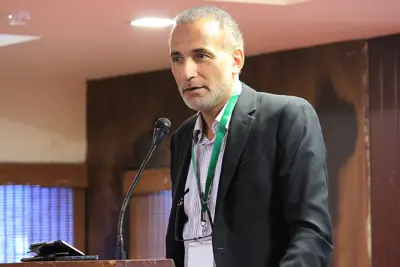
Tariq Ramadan is a Swiss Muslim academic, philosopher, and writer. He was a professor of contemporary Islamic studies at St Antony's College, Oxford and the Faculty of Theology and Religion, University of Oxford, but as of 2018 is taking an agreed leave of absence. He is a visiting professor at the Faculty of Islamic Studies at Hamad Bin Khalifa University in Qatar, and the Université Mundiapolis in Morocco. He is also a senior research fellow at Doshisha University in Japan. He is the director of the Research Centre of Islamic Legislation and Ethics (CILE), based in Doha. He is a member of the UK Foreign Office Advisory Group on Freedom of Religion or Belief. He was elected by Time magazine in 2000 as one of the seven religious innovators of the 21st century and in 2004 as one of the 100 most influential people in the world and by Foreign Policy readers (2005, 2006, 2008–2010, 2012–2015) as one of the top 100 most influential thinkers in the world and Global Thinkers. Ramadan describes himself as a "Salafi reformist".
