Hague Convention Quotes
The laws, rights, and duties of war apply not only to armies, but also to militia and volunteer corps fulfilling the following conditions: To be commanded by a person responsible for his subordinates; To have a fixed distinctive emblem recognizable at a distance; To carry arms openly; and To conduct their operations in accordance with the laws and customs of war
In the Afghanistan and Iraq Wars the U. S. government was much criticized for not treating captured Taliban and others as prisoners war. This Article is their main justification. The Taliban and Al Quida did not meet most of the criteria and therefore the convention did not apply to them.
Laws and Customs of War on Land (Hague IV), The Qualifications of Belligerents, Article 1, October 18, 1907
Sourced by: Eigen's Political and Historical Quotations


The Justice Department and the White House were arguing that the Geneva Conventions did not apply to terrorist groups. See {589865}.

When the Union army began using Blacks as recruits, the South threatened to execute any Negro soldier they captured. Some Southerners opposed execution but favored enslavement of captured Northern Black soldiers. The Lincoln threat seems to have worked, although Lincoln opposed executing Southern officers in retaliation for the atrocities at southern prisoner of war camps
This is true. There never has been any International law that made a belligerent responsible for civilian damages and deaths that were the result of collateral damage. However, the United States over the years, more so than any other country. Provided huge amount of aid to the citizens of the enemy nations although there was no legal obligation to do so.


These three conditions appear in virtually every convention on war and are basic to international law on the subject. For years they stood unquestioned, but in the latter half of the 20th century, guerilla warfare and revolutions began to pressure the definitions which were most strained in the War on Terrorism at the beginning of the 21st century. Starting with the Taliban in Afghanistan and then including Al Quada, the question of who was a combatant was debated anew. Using the classic definitions, the “foreign fighters” were not combatants and the Al Quada cells also met none of the three conditions. They could have been executed as spies as they were not in uniform according to some legal interpretations; others argued that they should be tried by civil courts; others, that they had no legal status offering any protections and it was in the discretion of their captors.

In WWII the Germans bombed London causing many civilian casualties. In retaliation, the allies bombed German cities such as Hamburg and others. The resolution’s effect was very short lived. There are similar restrictions in the Geneva Conventions but again, if one side breaks the conventions, most other sides will retaliate. Note that in the 3rd condition, the one that is most contentious in the 21st century “negligence” is the operative word. An error or mistake is not necessarily or even usually negligence. Many people believe that international law prohibits the bombing of civilians from reading 3) and similar statements from treaties. However, an honest error, mistake or equipment malfunction which kills


Calley was the officer who gave orders to kill men, women and children of My Lai, a Vietnam village which Army intelligence felt had been sympathetic and given help and assistance to the Viet Cong. Calley was convicted by Court Marshall, but was released after serving a very light sentence. No one above Cally was held in any way responsible.

Lawrence of Arabia. In the Middle East, Lawrence led a small Arab army against the Turks and the Germans. In a battle near Tafas, the captured 250 Turkish and German soldiers as prisoners. They them shot them all in cold blood with their Hotchkiss machine gun. What makes this quotation so significant is that one of the great British heroes of WWI was actually guilty of War Crimes. An American journalist gave Lawrence and his exploits great publicity without mentioning the atrocities. The British chain of command also ignored the transgression of one of the most fundamental rules of war even though the clear evidence was in basic battle report files. However, the British never removed the report from the files or destroyed it. The Turks and the Germans while they respected the rules of war with the English, French, and most allies, treated the Arabs much more harshly and murdered Arab prisoners on many occasions. In part this atrocity at Tafas was an act of vengeance and retaliation. But Lawrence never even tried to explain it.


In the Iraq and Afghanistan Wars, private contractors wlere hired to provide many services in the war zone including intelligence, security and guard service. In carrying out their responsibilities, some private contractor employees killed and/or tortured suspects or innocent bystandarders against the laws of the United States. If American soldiers had committed these crimes, they would be court marshalled. However, the Code of Military Regulations and other laws applied only to armed forces personnel.
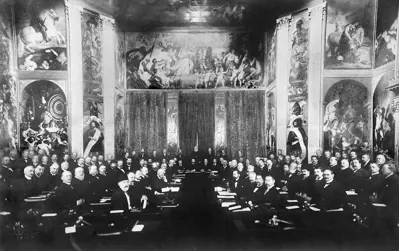
The Hague Conventions of 1899 and 1907 are a series of international treaties and declarations negotiated at two international peace conferences at The Hague in the Netherlands. Along with the Geneva Conventions, the Hague Conventions were among the first formal statements of the laws of war and war crimes in the body of secular international law. A third conference was planned for 1914 and later rescheduled for 1915, but it did not take place due to the start of World War I.
