Third Council of Toledo Quotes
The King will tolerate no one in his kingdom who is not Catholic
The origins of the extreme religious intolerance of Spain occurred centuries before the excesses of the Spanish Inquisition. Before the Conference the Visigoths and their king had been converted to Christianity but not all cared for the new religion.
3rd Toledo Council, Council of Catholic Clerics, Resolution, Toledo, Spain, May 589
Sourced by: Eigen's Political and Historical Quotations

This was the beginning of the inquisition.


Toleration is a relative term. The Muslim Moors made Christians (and Jews) pay a special tax. At times they were forced to wear special clothing so that they could be readily identified. And they could not build churches larger or taller than the smallest mosque in the community. At times, their occupations were restricted but at other times Christians and Jews were appointed to the highest positions like Vizier. The Inquisition, in contrast, forced all Muslims (and Jews) to leave the country without any of their property or money or be tortured and killed—usually by burning at the stake unless of course that they converted to Christianity.

Louisiana was then a possession of France
The letter was in response to the King’s letter commanding him and all the other governors to massacre all the Protestants in his district. Montmorrin, a Catholic, died suddenly and shortly thereafter. It is supposed he and one other objector (Viscount Orthez) were poisoned by order of King Charles. All the other governors obeyed and 50,000 Protestants were murdered in the Massacre of Saint Bartholomew.
In one of the historical ironies of the 12th century, a Christian sect preferred the rule of the Muslims than their Christian brethren—on the grounds of religious tolerance. It illustrates the changes that take place over time. By the 21st century, it was the Christians who were thought of as tolerant and the Muslims as the opposite.

Jews were forced to convert to Catholicism under penalty of death. While the archbishop did not approve, he did not describe the murders in moral terms or used his great religious power to stop the practice.

Wesley had been to Island several times and was interested in affairs there. He was a strong advocate of freedom of religion but the violence of the earlier religious conflict made him very wary of the Irish Roman Catholics who seemed to him particularly prone to religious violence.


This was the second liberal constitution in the world following on the heels of United States Constitution upon which some of this constitution is based. See {585394}. This particular clause is noteworthy for its internal contradiction regarding freedom of religion. After making it illegal to convert any Catholic to any other religion, the constitution goes on to establish freedom of religion. So one was guaranteed the right to practice one’s own religion but if the religion advocated evangelizing and converting others, that part of religious freedom was banned when targeting Roman Catholics.

See {586039} for a quotation that goes further and seeks to punish and humiliate the non believers. This sura is often used by those wishing to illustrate the intolerance of Islam—especially of other religions. They fail to put this into the context of the Old Testament which proscribed death for heretics or the history of Christianity regarding the murder of nonbelievers. The difference is however, that a very small proportion of Jews or Christians today believe in following Biblical instructions in this respect while the proportion of Muslims who believe in the literal interpretation of scripture on these points is much larger. However there are Islamic modernists and moderates throughout the world who reject this notion of warring on all other religions and there is a struggle going on within Islam itself.


It was not until 1780 that Catholics were allowed to even be members of Town Corporations.
While not in the Koran, this attributed statement is the basis for the ban on non-Muslims going on a Hajj and going to the most holy Muslim places—Mecca, Mina, Muzdalifa, and Arafat as well as the anti-religious hostility to all religions but Islam which is present in some Muslim countries.


The King, a religious exremist fanatic, was a great supporter of the Inquisition whose excesses were horrible during his reign.
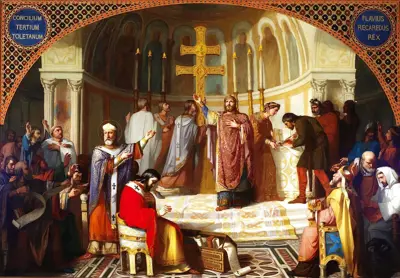
The Third Council of Toledo (589) marks the entry of Visigothic Spain into the Catholic Church, and the introduction of the filioque clause into Western Christianity. The council also enacted restrictions on Jews, and the conversion of the country to Christianity led to repeated conflict with the Jews.
