Anne Boleyn Quotes
The king has been very good to me. He promoted me from a simple maid to be a marchioness. Then he raised me to be a queen. Now he will raise me to be a martyr.
King Henry had fallen in love with a commoner so he gave her a title. Then he married her and made her his queen. When he tired of her, he accused her of adultery for a queen was treason as it compromised the succession to the throne. Henry had the queen executed, and married another.
Anne Boleyn, 1501? - 1536, Queen of England, 1535
Sourced by: Eigen's Political and Historical Quotations

Adultery for a queen was considered treason. Adultery per se was not punished with death in 16th century England, but the concept was that a Queen who committed adultery was risking the royal bloodline and therefore the Crown and the Nation.


The children won't leave without me; I won't leave without the King]; and the King will never leave.
Asked about the possibility of the royal family evacuating London during the WWII blitz when London was being bombed regularly.


"King" refers to leaders of American Indian tribes.


“Picaninnies” is a derogatory term for Blacks.

The king was found guilty and was decapitated, but not wearing a crown.

She was unhurt when an assassin’s bullets did not hit her. There was an outpouring of affection, love, and thanks immediately after the assassination attempt.

Beaumarchais had provided the Americans with credit in the amount of ½ million French Livres. However, Beaumarchais served the French King Louis XVI as a spy and advisor on foreign affairs. The money had been secretly provided by the French government to help the American cause while still being able to officially deny to England that they were in any way involved in the rebellion. The American agent, Silas Dean, who arranged for the loan saw through the ruse. See {624186} and {624184}.

Jennings had been purchased by Webster and served as his personal butler. As such, and technically a free Black, Jennings had the run of Washington including the Capitol. Webster had freed Jennings with the understanding that Jennings would work off his purchase price. About a year before Jennings had fully worked off his freedom price, he organized a slave escape of Washington house slave by arranging for a ship, the Pearl, to take them North. He wrote his letter to Webster and then went to the docks where the slaves boarded the Pearl. At the last minute, he left the ship and returned to the Webster home feeling that he had given his word and to leave at that time would be dishonorable. The slaves sailed, but were caught by a posse shortly. Most of the slaves were sold as field hands to the deep South, but the white ship’s master, Daniel Drayton, was tried for stealing property. He was defended by Horace Mann, and fined an amount he could not pay and went to jail. The Pearl escape received much notoriety as the escapees were all very “privileged” slaves. Two years later in the Compromise of 1850, selling slaves on the open market was banned in Washington DC. Millard Filmore pardoned Drayton after 4 years in jail. Jennings completed his promise of service and was never prosecuted for his organization of the escape.


1st Duke of Wellington. The King was somewhat delusional, and there is no historical records of his ever having personally fought in the Napoleonic wars at all. This quotation has often been nominated for the most tactful in history.

For his seditious activities he was sentenced to penal servitude for life. He escaped and came to America where he entered politics

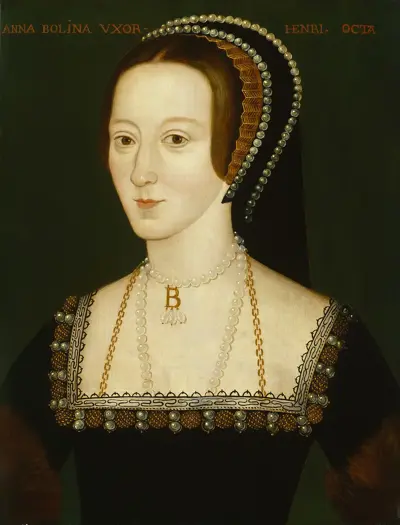
Anne Boleyn was Queen of England from 1533 to 1536 as the second wife of King Henry VIII. Their marriage, and her execution for treason and other charges by beheading, made her a key figure in the political and religious upheaval that marked the start of the English Reformation. Anne was the daughter of Thomas Boleyn, 1st Earl of Wiltshire, and his wife, Lady Elizabeth Howard, and was educated in the Netherlands and France, largely as a maid of honour to Queen Claude of France. Anne returned to England in early 1522, to marry her Irish cousin James Butler, 9th Earl of Ormond; the marriage plans were broken off, and instead she secured a post at court as maid of honour to Henry VIII's wife, Catherine of Aragon.
