Robert Byrd Quotes
The involvement of the government in military adventures always results in the expansion, at least temporarily, of Presidential power.
Robert Byrd, 1917-2010, U. S. Congressman & U. S. Senator (Democrat, WV), Senate Majority & Minority Leader, Speech, University of Louisville, April 17, 2000
Sourced by: Eigen's Political and Historical Quotations


The Attorney General had taken the position that the Congress could not pass laws in time of war that the President was required to follow if in his judgment as Commander in Chief, the war effort and safety of the nation was at stake—that he could instruct the military to ignore laws passed by Congress. The legal theory of the George W. Bush administration was that the President had “inherent powers” under the Constitution and that Congress could not supersede these by legislation.


That was an ironic statement. Shortly thereafter we invaded Mexico, occupied the country, pressured it into “selling us much of what is now the Southwest of the United States, and finally left.


When the Senate was debating the Gulf of Tonkin Resolution, which would empower the President to take "all necessary measures" to repel any armed attack on U. S. forces, Senator Morse was one of only two Senators opposing the resolution:


After American troops were deployed to Saudi Arabia following Iraq's invasion of Kuwait:

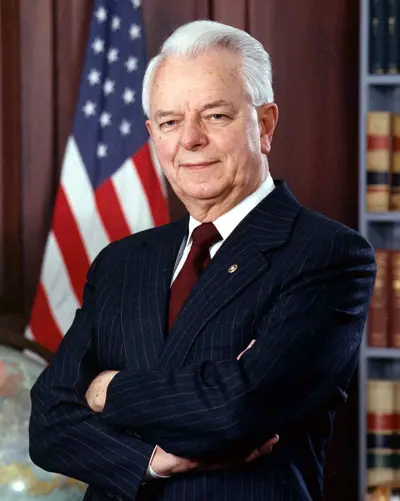
Robert Carlyle Byrd was an American politician who served as a United States Senator from West Virginia for over 51 years, from 1959 until his death in 2010. A member of the Democratic Party, Byrd also served as a U.S. Representative for six years, from 1953 until 1959. He remains the longest-serving U.S. Senator in history; he was the longest-serving member in the history of the United States Congress until surpassed by Representative John Dingell of Michigan. He was the last remaining member of the U.S. Senate to have served during the presidency of Dwight Eisenhower, and he was the last remaining member of Congress to have served during the presidency of Harry S. Truman. Byrd is also the only West Virginian to have served in both chambers of the state legislature and both chambers of Congress.
