John Hunt Morgan Quotes
The Home Guards are required to come in at once and deliver up their arms, those who fail to do so will be regarded as enemies of the Government and treated accordingly.
Morgan, John Hunt. "Proclamation." The War of the Rebellion: A Compilation of the Official Records of the Union and Confederate Armies, series 1, vol. 16, pt. 1, Government Printing Office, 1880-1901.


For the required Oath, see {623308} . There were several to the amnesty. These included graduates of West Point and the Naval Academy who had joined the rebellion, senior officers and officials of the Confederacy, those who were accused of war crimes and abusing Union prisoners of war, persons who went abroad to help the Confederacy, and Northerners who had gone South to aid the rebellion. Many scholars think that although Lincoln had expressed his desire to provide an amnesty after the war was over, he probably would have been more lenient than Johnson who exempted many on the Southern side—especially the leaders. Ironically, Johnson was a Southerner but was personally, morally outraged at taking up arms against the United States and in that sense was much more of a hawk than Lincoln and many of the radical Republicans even. However, he was an inveterate racist and resisted most of the attempts to implement equality during the Reconstruction. Many argue that but for Johnson, Reconstruction might have been much more successful. It was easy for Southerners to resist equal rights for Blacks when they knew that the President was also opposed to measures to produce equality.


The ultimatum was rejected, Cromwell’s forces took the town and massacred the defenders as well as many civilians. See {632366}.

This quotation shows that the dissent leading to the American Revolution did not emerge suddenly in 1776 after the Battle of Bunker Hill. Dissent, sedition and even violence was documented here in 1774. Salem at the time was the second largest port in the colony and the customs tax collectors—Loyalist Americans—were run out of Salem.

This was one of the several early unofficial Emancipations that was issued in the Civil War.

His refusal to explain the reasons for and the circumstances of the arrests drew much criticism from Democrats and the press. This was the precedent that Presidents have used ever since to not reveal the grounds for arrest and the circumstances thereof. George W. Bush aides specifically cited this when they refused the details of many of the arrests after the 9-11 attack.


Committee of the Congress. This was the prevailing Congressional and public view except for the South which had coalesced around an intellectual rationalization. See {618013}.

With martial law came the authority to seize ALL guns in the colony for the emergency. This was not to disarm the general populace. It reflected the fact that there were relatively few colonists who owned guns as they were very expensive. The Governor could take those that existed and use them to defend against the rebels or whatever. There were more gun owners in the Revolution but still a minority. Even after the War of 1812 only 30% of Americans were armed, and that shortly decreased to 10% as there was no real culture of gun ownership in early America. This would come around the Civil War.

Italy was in the midst of civil war with the rebels in Emila wanting its independence from the civil authority of the Pope who then controlled virtually all of Italy. The French emperor, Napoleon BonaparteII, advised that the only way to produce peace was to allow Emila to have its independence. He was the last Pope to hold temporal power. While it should not be surprising, the Pope’s statement is essentially the same position that every autocratic authority has taken when there has been some local success of the rebels.


government appointed officials and bureaucrats Savonarola was a very hated ruler, opposed to any kind of a Parliament or assembly. And the penalty for advocating for a Parliament was severe. The Signoria were the various government appointees and clerks. They were influential in Florence and hence they were silenced by the mot draconian methods. There was a movement throughout Italy for parliaments and less arbitrary government. Savonarola was particularly strict in his rooting out sin and cruel in his punishments and hence very unpopular. He was also under the delusion that God himself had called on him to preach his strict version of morality. Some of the Nobles reached the Pope with many of Savonarola’s extreme statements and Savonarola was excommunicated and burned as a heretic. His executioner gloated that he was burning Savonarola before the powerful priest could burn him as he had done so many others.

This part of the war was particularly bloody as Marion and his opponent Colonel Tarleton both committed atrocities and war crimes against the civilians who supported the other side or tried to remain neutral. Marion was promoted to General.
There was some political pressure in the North, to offer terms to the South where they could cease the rebellion and return to the Union and return to the status quo ante—before the rebellion.


He was of course not the President then. But the stands that politicians took with respect to the rebellion of the South often determined their political futures. See {640751} for another future President’s quotation on the subject.
This was his name for the wealthy slaveowners in Tennessee. He was the military governor of Tennessee when he so labeled the secessionists.

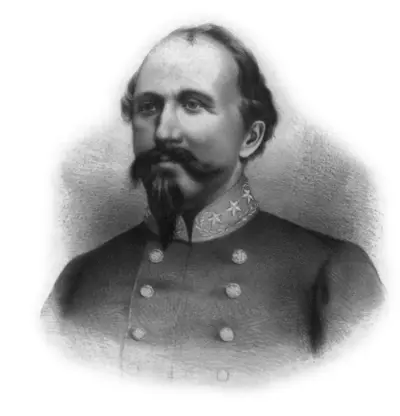
John H. Morgan was a Confederate general in the American Civil War.
