Fitz-Hugh Ludlow Quotes
The hand of the Church holds the souls of the saints by inevitable purse strings … Over all these matters Brigham [Young] has supreme control. His power is the most despotic known to mankind. Here, by the way, is the constitutionally vulnerable point of Mormonism. If fear of establishing a bad precedent hinder the United States at any time from breaking up that nest of all disloyalty, because of its licentious marriage institutions, Utah is still open to grave punishment, and the Administration inflicting it would have duty as well as vested right upon its side, on the ground that it stands pledged to secure to each of the nation's constituent sections a republican form of government, something which Utah has never enjoyed any more than Timbuktu.
The use of “despotic” did not imply cruelty or even poor management of the society. The term was used to indicate that Brigham Young, the then Mormon Leader, had the powers and authority of a dictator. At the time most Americans in the East knew little about the Mormons. Ludlow was one of the early observers of Mormon society in Utah who wrote about the Mormons in popular—albeit intellectual—magazines. Ludlow regarded Mormonism as it was then practiced as incompatible with, and dangerous for, America, not because of the plural marriage, but the conflicts with the concepts of democracy and self-government. The authority that Brigham Young and the church then exercised over civil life was what distressed him and many other Americans.
Fitz-Hugh Ludlow, 1836–1870, Author, journalist, and explorer, “Among the Mormons”, The Atlantic Monthly, April 1864
Sourced by: Eigen's Political and Historical Quotations

The Mormons wanted Utah to be a United States territory or a state with an extreme state’s rights mentality whereby their religious doctrine in the Book of Mormon could be state law and at the time the Constitution had not yet been amended to require the state governments to adhere to the Bill of Rights or other Federal laws. In effect they wanted a democratic type of theocracy. See {619869}. The Mormons would not agree that Federal law should govern their community or people, and war with the Federal government was imminent. In an ironic twist, Johnson, a Texan, rebelled against the nation himself several years later when he became a Confederate General. He was the highest ranking Confederate Officer killed in Battle—at Shiloh.


The struggle in the Catholic Church reached an amazing state. Just after a new pope, Martin V, had been elected the Council of Bishops at Constance came up with this notion which placed their views above those of the Pope under the theory that this particular council derived its power and authority directly from Christ while the pope was only God’s “vicar on earth.” The struggle was somewhat akin to the inevitable struggle for power between an executive branch and a legislative branch. The Council’s ascendancy didn’t last very long and was repudiated by successive popes.

Waite said that exempting plural marriage from criminality under the guise of religious freedom was to make religion superior to the law

Ivan the Terrible. He was referring to himself as God’s Chosen One. He and the Church were aligned against the Nobles, whose lands Ivan wanted. He would execute hundreds of “traitors” every month. He even executed the families of his enemies in very cruel ways. He claimed to be “cleansing” the land of sinners in preparation for the coming judgment day, and the church backed him up on this. The Church gave him carte blanche to “punish” all sinners and his paranoia eventually got around to the church fathers themselves who became the final victims.

Federal officials and commissioners issued laws, directives and orders that were very unpopular with the Mormons who were in the overwhelming majority of the Utah territory. The Mormon “government” was a type of theocracy but a very popular one. The Mormons tried to test the constitutionality and legality of the Federal laws and orders before they would obey. The government position was that they should obey and then could test the laws in the courts. The Mormons eventually lost in the courts anyway, but the principle of obedience to law until it can be tested and reversed has generally been the rule of U. S. Law. However, civil disobedience in which many religions have engaged in our history argues the obverse. Eventually Taylor had to go “underground” and rule the church from exile in which state he died.
Von Wackerbarth was one of the many Mormon haters of his day. His quotations have value not for the accuracy of the facts which are scant, but to indicate what much of public opinion regarding Mormons was in that day.
Von Wackerbarth was one of the many Mormon haters of his day. His quotations have value not for the accuracy of the facts which are scant, but to indicate what much of public opinion regarding Mormons was in that day.
The church was in constant roil with the Bishops, the Pope and the Holy Roman Emperor each striving for superiority over the other two, almost like branches of government fighting for power. This was the bishops attempt to “impeach” the Holy Roman Emperor who was never charged or given an opportunity to face or refute the charges. He was not even present at the Council. See {611260} for his reply.


Despite his recognition of this point, he too became an advocate of murdering religious opponents.

opposition to the church of the time

While that is certainly true and has been borne out by history, the same thing can be said of democratic rulers and even many democratic politicians of lower rank. Yes men abound and not politicians not only want them but arguably need them in order to maintain the assurance and positivity that most voters associate with good leadership.

The monetary corruption of the Church and many of its priests did not go unchallenged by Catholics of the day.

This editorial was an excellent summary of the issue of Mormon polygamy where both sides are described. The Thugs were a violent religious sect in India where females were forced into marriage.

McClellan thought President Lincoln an oaf and toyed with the idea of taking over. Ironically, he was a terrible battle general and never would have any reasonable success on the battlefield.

Five years earlier, Young had all but given up on the idea of converting Native Americans—see {619863} and {619863}. Young was very ambivalent about the Indians, at some points wanting to convert them and on others to have them removed from the area to make way for Mormon growth and development--{619865}. At this time, the Mormons and the Federal Government were at loggerheads regarding the requirement for enforcing Federal law in all territories including Utah. Young and others hoped to enlist Indian warriors in any potential battles with the army.

Trajan ande Caligula were each Roman Emperors.
We count on Mormon assemblages to


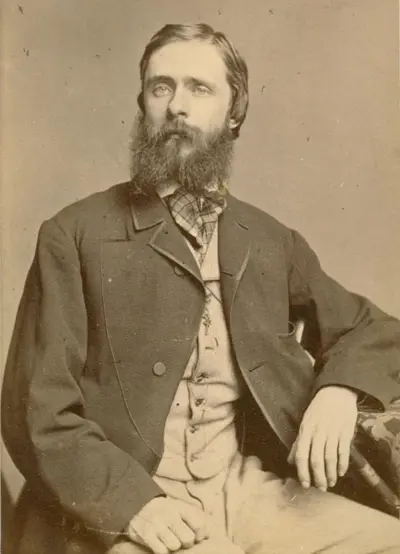
Fitz Hugh Ludlow, sometimes seen as Fitzhugh Ludlow, was an American author, journalist, and explorer; best known for his autobiographical book The Hasheesh Eater (1857).
