Albert Einstein Quotes
The great scientist was offered the Presidency of the young state of Israel:] I am deeply moved ..., though also sad and abashed that it is impossible for me to accept this offer. Since all my life I have been dealing with the world of objects. I have neither the natural ability nor the experience necessary to deal with human beings and to carry out official functions.
Albert Einstein, 1879-1955, Nobel laureate in Physics, Letter to Abba Eban, November 18, 1952
Sourced by: Eigen's Political and Historical Quotations


In response to a newspaper editor who told Jackson some of his friends advocated him for the Presidency:

This is an important quotation because it was believed by most of the Founding Fathers and the American public until relatively recently. Presidential candidates would not think of publicly campaigning. The view was that anyone who was ambitious for power and authority should not be trusted with it. The idea was first stated by Plato and has been a major view of Western politics since. Many still believe it, but no one has come up with a practical alternative in a large jurisdiction where there is no way to know about the possible candidates without their initiative. Earlier American presidential candidates, although they did not campaign as we know it, got associates to do their campaigning for them. At Presidential nominating conventions, candidates would not even attend. Abraham Lincoln for example never attended the convention at which he got nominated, but he had associates lining up delagates and he was managing their efforts behind the scenes.


He had been asked by some politicians if he would be interested in being an Iralian senator.


The first non-PRI President in over 70 years. Before Fox, the corruption of Mexican Presidents was rampant.


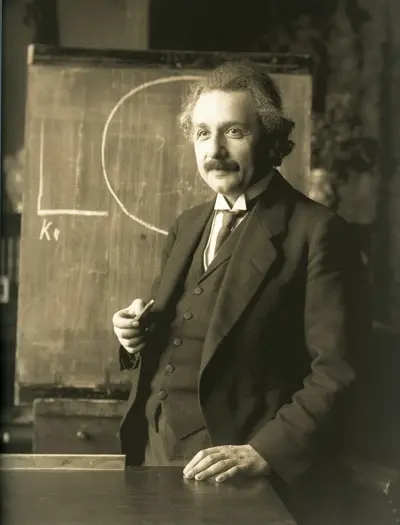
Albert Einstein was a German-born theoretical physicist, widely acknowledged to be one of the greatest physicists of all time. Einstein is known for developing the theory of relativity, but he also made important contributions to the development of the theory of quantum mechanics. Relativity and quantum mechanics are together the two pillars of modern physics. His mass–energy equivalence formula E = mc2, which arises from relativity theory, has been dubbed "the world's most famous equation". His work is also known for its influence on the philosophy of science. He received the 1921 Nobel Prize in Physics "for his services to theoretical physics, and especially for his discovery of the law of the photoelectric effect", a pivotal step in the development of quantum theory. His intellectual achievements and originality resulted in "Einstein" becoming synonymous with "genius".
