Yasser Arafat Quotes
The goal of our struggle is the end of Israel, and there can be no compromises...
Arafat, Yasser. Interview. The Washington Post, 29 Mar. 1970.


This resolution has never been rescinded. Some Arab states have abandoned this resolution and negotiated peace and recognition such as Egypt. The majority of the Arab States did and do not want peace with Israel. They did and do not want to recognize Israel and they did and do not want to negotiate. But they often blame Israel for being intransigent in the peace process. Many Arabs want a peace treaty and want to negotiate but the extreme rejectionists generally dominate Arab politics.


This statement hardened the Israeli population away from anything that would bring Hamas more power. The PLO leader had, for ALL the Palestinian people, recognized the right of Israel to exist {633062}. Now Hamas was not only reneging on the Arafat declaration, but also would not even use the term “Israel” and instead calls the nation which in less time than the Palestinians have had, has developed a modern, industrial, democratic state far in advance of the Palestinians or any of the Arab nations for that matter. Yet it is relegated to a “project” with the great hope of having it come to an end—the destruction of Israel. The Israelis observe that this is a de facto declaration of war, and hence treat Gaza and Hamas as an enemy force to be reckoned with. See {635338} for another alarming reneging of the recognition of Israel.


The Palestinians were split between supporters of Hamas and Fatah. The former was a terrorist organization which refused to recognize the right of Israel to exist and whose charter called for the killing of all Jews. The latter, accepted the right of Israel to exist and was committed to peace and coexistence with the Jewish state. They had fought a civil war and Hamas controlled Gaza with well over 1 million people which they seized for force and killed of forced out Fatah Representatives. Fatah was the elected ruling party of the West Bank, the larger and more populous of the Palestinian territories. There was little chance of any peace given that split. However, Israel which had undergone over 7000 rockets fired upon them by Hamas, stated that they refused to negotiate with the Palestinians as long as the Hamas terrorists were a part of the control of the potential Palestinian state. They would only discuss a 2 state solution if Hamas agreed that they accepted the right of Israel to exist in their general territory as a Jewish State, Hamas would accept and follow previous agreements made with the Palestinians, and Hamas would give up terrorism and the objective of killing Jews. So either Hamas would have to change its policies or Israel would negotiate with an organization that claimed it would never accept the existence of that country as a Jewish state. Al-Masri thought that the agreement he had mediated, was a necessary first step and was constructive for all the parties.


This quotation is the basis of the Arab argument that the United Nations decided that the Palestinian refugees who left Israel upon its creation at the urging of some Arab leaders. Other’s opposing this point of view observe that only the Security Council’s resolutions are binding and the General Assembly resolutions have no weight in International Law. Further that the Arab Refugees do not want to “live at peace” as is required in the resolution. Numerous surveys demonstrate the desire of most of the Palestinian refugees to support efforts to expel the Jewish Israelis from Israel. The other barrier is that there are tens of thousands of Jews who were forcibly ejected from Arab countries for whom no country is offering a right of return. The irony of Resolution 194 is that it was opposed by every Arab country at the time.
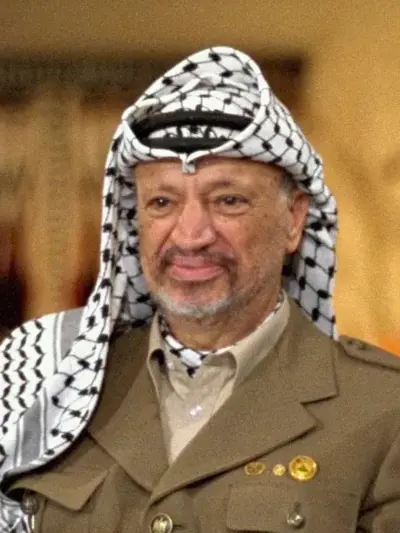
Mohammed Yasser Abdel Rahman Abdel Raouf Arafat al-Qudwa al-Husseini, popularly known as Yasser Arafat (Arabic: ياسر عرفات, romanized: Yāsir ʿArafāt) or by his kunya Abu Ammar (Arabic: أبو عمار, romanized: ʾAbū ʿAmmār), was a Palestinian political leader. He was Chairman of the Palestine Liberation Organization (PLO) from 1969 to 2004 and President of the Palestinian National Authority (PNA) from 1994 to 2004. Ideologically an Arab nationalist, he was a founding member of the Fatah political party, which he led from 1959 until 2004.
