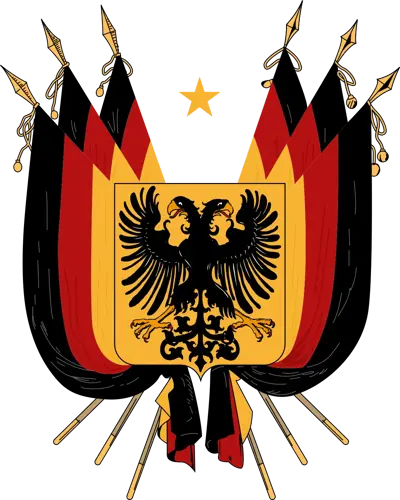
Vorparlament Quotes
The German Union proclaims the partition of Poland to be a shameful injustice, and considers it the sacred duty of the German peoples to do their utmost to achieve her reconstitution.
Russia had partitioned Poland into a Western part inhabited by Poles and many ethnic Germans, and an Eastern part of Poles and ethnic Russians. The latter was made part of Czarist Russia.
Vorparlament, German Revolutionary Parliament, Resolution April 1847
Sourced by: Eigen's Political and Historical Quotations


The “proofs” were diplomatic assurances—treaties—that England would guarantee the territorial integrity of Belgium. The British made strong diplomatic efforts to persuade Germany not to occupy Belgium. The German’s none the less send armies in under the excuse that if they did not, the French would occupy the country and have a strategic advantage over them. Diplomacy could do no more good. England had to send troops or renege on its obligations. So England was in WWI.

In 1884 Germany had become active in its colonization and outmaneuvered England in taking over Cameroon. Then Germany showed some interest in a part of New Guinea. The English resisted, not for any geopolitical reasons but because the British leaders did not want to be bested by Bismarck.


Franco based much of his state on the Fascist examples of Germany and Italy at the time.

The Japanese have always been very race conscious seeing themselves as the racial pinnacle of Asian peoples and others as inferior. The peoples of Okinawa were not the racially pure Japanese and MacArthur turned out to be right that protection of Okinawan rights, prerogatives, and dignity was much less important than for ethnic Japanese. It would not be until the last decade of the 20th century that Japanese public opinion was seriously concerned about the Okinawans. Even then, Japan’s independence and dignity as a sovereign nation appeared more important than the rights and dignity of the native Okinawans.


Commenting on Israel's right to exist:

The German designs for Polish destruction began long before World War II. Poland, created by the Treaty of Versailles, was seen be fanatic Germans as an example of French Hegemony.


He was one of the first democratic politicians of Germany who argued for rapprochement between France and Germany and may have been the first to suggest a European Union. Most of the world was very distrustful of German nationalism, and Stresemann presented one of the positive aspects of it. He died of a stroke in 1929 and the political vacuum was eventually filled by Hitler and the Nazis as the Weimar Republic was short lived. As democratic as Stresemann was, he still was preoccupied with German territorial control. Germany’s aggression in WWI led to a peace treaty that fixed borders that were always contested by Germany. The German position was that if there was an area or France, Poland, or other country where there was a community of German speaking people, then that area should be a part of Germany. This was one of the main reasons for Germany’s aggression on WWII.

The PLO and most of the Arab nations, took the position that the United Nations original partition of Palestine into a Jewish and a Palestinian nations -- UN General Assembly Resolution 181 – was “illegal”. That view has served as the basis for the Arab Israeli problems since. The basis of the illegality they claimed was the right of the Palestinians to self determination. However, it is a right which they deny to the Jews living in Palestine who also had a right to self determination. The UN solution was to partition the land into two nations so that the each had the right of self determination. However, the Arab leadership wanted only Arabs to have the right of self determination.


1st Viscount Grey of Fallodon. He was advocating British entry into WWI in defense of the Neutrality of Belgium as was their treaty obligation.


Hobson, like Mark Twain in America, was a major critic of imperialism.