Samuel Shaw Quotes
The day of our arrival at Canton, August 30th, and the two following days, we were visited by the Chinese merchants … and treated by them in all respects as citizens of a free and independent nation. As such, during our stay, we were universally considered. The Chinese themselves were very indulgent towards us, though, ours being the first American ship that had ever visited China, it was some time before they could fully comprehend the distinction between us and Englishmen. They styled us the New People; and when by the map we conveyed to them an idea of the extent of our country, with its present and increasing population, they were highly pleased at the prospect of so considerable a market for the productions of their own empire.
Congress was delighted with this report. This quotation is interesting for a number of reasons. In this first contact between Americans and the Chinese, foreign trade was the main subject of interest, and when the Chinese saw the size of the new nation, their immediate interest was to sell America Chinese manufactured goods. By the start of the 21st century, the largest trade the world had ever seen was that between American and China with us getting Chinese manufactured goods just as the 1785 Chinese and Americans at this meeting envisioned.
Samuel Shaw, 1754-1794, Revolutionary War Major, First U. S. Consul to China, Report to the American Minister of Foreign Affairs (John Jay), May 19, 1785
Sourced by: Eigen's Political and Historical Quotations


She was ruling the largest country in the world and Denby’s opinion was held by most who knew China. What made her all the more remarkable was that, as a Chinese lower middle class women, she had no formal education, had rarely been allowed to travel out of her home or interact with men. As a young teen she was made a concubine to the Emperor and rarely left the harem. Like Abraham Lincoln she was self-taught and not only was able to seize power in China without any male advisor or patron, but she ruled as well as any world leader. In her later years she was pushing her country too fast and far, and the Western Powers had caused much domestic difficulty and to maintain power, she had to ally with the anti-West Boxers causing her reputation amongst Westerners to sink dramatically and thereafter was never much acknowledged for her remarkable political skills and accomplishments.


The British had, after earlier defeats, finally had great military success in India/Afghanistan on the one hand and China on the other. Note that the objects of the military expeditions were always twofold: First to expand trade and trading opportunities for England. Second to retrieve “honor” that had been lost by earlier military defeats.

He was advocating a relationship with the American Revolutionaries and some skeptics were concerned about what would maintain the relationship over time.


Shaw carefully reported on the customs, laws, and traditions of foreign trade with China. He counted 43 European ships that landed in Canton in 1887 full of goods to trade and left full as well.


She had read reports that Chinese faced in several lands of the West. The worst of these were Peru and Cuba where Chinese emigrant labor were kidnapped and worked in slave conditions. Prior to Cixi, Chinese Emperors had little or no concern for the laborers and peasants in their own country much less those Chinese who had gone abroad in search of a better life.


At the time of this quotation, he was the President of the America-Mexico Chamger of Commerce and his Mexican members were very anxious or disturbed by the prospect of Donald Trump being sworn in as President. Trump, during his presidential campaign, had courted many of the anti Hispanic voters and organizations, had labeled Mexican immigrants as "criminals" and "rapists", and had promised to build a very high wall accross the Mexican U. S, border and "make the Mexican's pay for it." Zapanta was also under consideration by President Elect Trump as the U. S. Ambassador to Mexico. These words were particualy well and delicately chosen to try and maintain his staning with with Trump and the Mexican leadership.

Although, on sever occasions Mao tried to reach out to the United States, the fact that he was leading a communist movement and Chiang Kai-shek, our recognized ruler of China hated Mao caused his overtures to be rebuffed. American military leaders knew very little about China and our intelligence was almost non-existent. They assumed that he was under the control of Russia and Joseph Stalin when in fact, the Russians wanted to oust Mao for not following Stalin’s communist orthodoxy. They succeeded in firing him as head of the party and replacing him with a committee of more loyal communists. Not only did the US rebuff Mau’s outreach attempts, but American money and military material financed 6 different military campaigns by Chiang to exterminate Mao and his communists.
None succeeded as the vast majority of the peasants supported Mao and his troops and provided support and information in Chiang’s attempts. Some historians believe we “bet on the wrong horse”.

At the time, the President wanted to get Chiang to fight aggressively against to Japanese when he was taking large amounts of American monetary aid and military equipment but using it to try and exterminate Mao and his Communists who were fighting the Japanese. FDR was clearly trying to flatter Chiang and his wife and gain political points with the China Lobby but it is not known whether or not he really believed this and other statements. Chiang was a vicious, cruel, corrupt military dictator but he had become a “Christian” and always spoke of the importance of democracy of which there was none in China. Our intelligence from China was very bad at the time, with the secret reports of General Stillwell (the senior American military man in China) and that of a few state department China hands were in total contradiction to the Public information that the President was receiving from Henry Luce and his Time Magazine and the large China Lobby, much of which was ironically paid for with the American AID money given to China. So it is not known whether Roosevelt actually believed this and other statements or was just being diplomatic.
See {641838} for a quote about the policies that she came to regret.

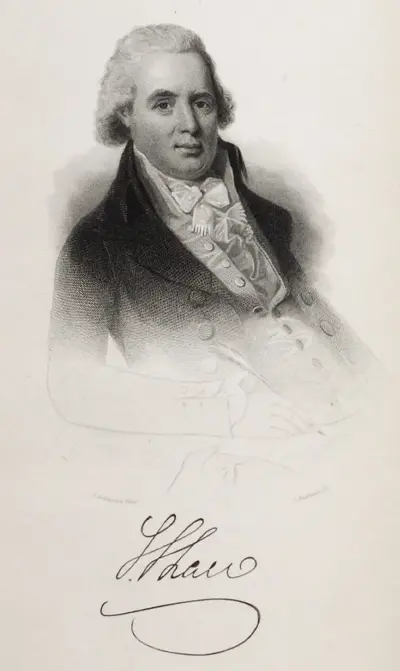
Samuel Shaw was an American Revolutionary War army officer and diplomat, who served as the first United States consul to China.
