Samuel Johnson Quotes
The danger of unbounded liberty [of printing], and the danger of bounding it, have produced a problem in the science of Government, which human understanding seems hitherto unable to solve.
Samuel Johnson, 1709-1784, English Writer & Lexicographer, Lives of the English Poets, 1781
Sourced by: Eigen's Political and Historical Quotations


The Masses was a left wing publication which the then Post Office officials decided were “dangerous”. Later, the Supreme Court would hold that there could not be this degree of political censorship by Post Office officials.


Originally it was published in Boston under the name “A Columbian Patriot.” This was written before the Bill of Rights had been added. Criticism like this led to their addition by Congress in order to obtain ratification.

The segment to which he referred were corporations. In his view, the then existing limits on corporate contributions to political campaigns were a “muffling” of the most experienced economic operatives in our society—corporations. Therefore this was censorship of the corporation’s right to freedom of speech. So in his view, in addition to the rights that were abrogated the nation was being blocked from receiving the political voice of one of its best sources of experience and wisdom regarding economic matters. The Supreme Court with the George W. Bush appointees became much more conservative and a few years later, with Scalia leading the charge, the court overruled itself and all its precedents and decided that Corporations were entitled to free speech. See {642321} for an earlier Supreme Court view that corporations were not entitled to the protection of citizens. This Scalia statement was quoted by fellow Supreme Court justice Anthony Kennedy in one of his opinions.


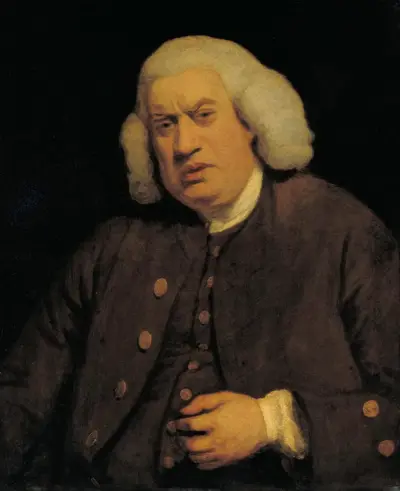
Samuel Johnson, often referred to as Dr Johnson, was an English writer who made lasting contributions to English literature as a poet, playwright, essayist, moralist, literary critic, biographer, editor, and lexicographer. Religiously, he was a devout Anglican, and politically a committed Tory. The Oxford Dictionary of National Biography describes Johnson as "arguably the most distinguished man of letters in English history". He is the subject of James Boswell's The Life of Samuel Johnson, described by Walter Jackson Bate as "the most famous single work of biographical art in the whole of literature".
