Arthur Capper Quotes
The cost of nitrates used in fertilizer is altogether too high. This is commonly admitted. We have been paying tribute for years and years to the country which has the only large source of this essential commodity, Chile. Most of the revenue of that government for a generation has come from an export tax, something which America has never had, on this supply.
American agriculture truly became independent when the British and American chemical industry learned to produce artificial nitrate which was important for military explosives as well as fertilizer. Chile, which had not developed many other revenue sources suffered.
Arthur Capper, 1865-1951, Governor of Kansas (Republican), U. S. Senator (Republican, KS), “The American Farmer and Foreign Policy”, Foreign Affairs, March 1923
Sourced by: Eigen's Political and Historical Quotations

Manava Dharma Shastra. These were the proper allowable taxes in the Ancient Hindu system. This translates to two percent of cattle or gold and at most 17 percent of the crops. Most industrialized democracy citizens would be very happy to have this low a tax burden. Conversely, the tax rates of modern democracies are sinful by Ancient Hindu standards. This text is a part of the Hindu Holy Texts. Hindus believe that Manu was a prophet whose text is revealed or inspired.


He was a rice planter but could only export his rice to English Merchants and not sell to other foreign markets. This was the same with tobacco and other commodities. See {636867}.


As opposed to having tax collectors within the United States. At the time, import duties were the only taxes Jefferson approved of.
If a state has substantial natural resources, the rulers and their close supporters can generate enough revenue for themselves without worrying about the industrialization of the nation, education, economic development which requires the health and education of the population. As a result, while “rentier” states seem rich, they very rarely improve the quality of life of most of their citizens.


Most Republicans at the time were beholden to corporations and business who then demanded high tariffs and other protectionisms so they could maintain high prices and not have to compete with British and European imports. Roosevelt and a few other reform Republicans were free traders along with most Democrats. Roosevelt had so many other reforms in the fire that he decided not to take this one on at the same time and thought that the benefit would not be good enough for the nation to offset the open civil war of the Republican Party that would ensue. In the latter half of the 20th century, large American companies had opened or invested in foreign corporations and/or were manufacturing many of their products abroad. So they then advocated free trade. When they did, the Republican Party flip flopped and adopted free trade as one of its basic principles. Meanwhile, the Democrats who were free traders in the early 20th Century had become protectionists by the end of the 20th century as labor movement wanted to protect American jobs.

In this case the tariffs were imposed not to protect national industries but to simply raise revenue. In the early years of the United States, almost all of the Federal Revenue was raised this way.
As a result of the Commerce Department efforts, the wheat farmers of America with the help of the Department of Agriculture radically changed wheat farming procedures and techniques and despite the Great Depression by the 1940s American wheat was first class quality and by the 1950s was the best in the world and American wheat farmers were also obtaining more yield per acre than the farmers of anywhere else.

Environmentalists counter with the fact that the corporate and government interests in growth at any cost will, and have in the past, found a loophole in every reasonable compromise that has been made. Reasonableness is only a device they use to slow regulation until they can either figure out a loophole or use their great fiscal resources to shape public thinking to soften or eliminate the regulation. Therefore some environments argue that they must be as ideological about the environment as the corporations are about their rights to profit and not compromise even when a compromise appears reasonable. Besides, if the corporations always appear to win, the public will think opposing them is futile. So when they can be beaten on something that is unreasonable, they appear weaker and encourage more environmental public activism.


There has always been pressure from different interests to exempt certain products from duty and place higher duties on others. Calhoun urged a policy that would be based on general economic prinicples and conditions and not on pressure from special vested interests. He was a senator at the time.
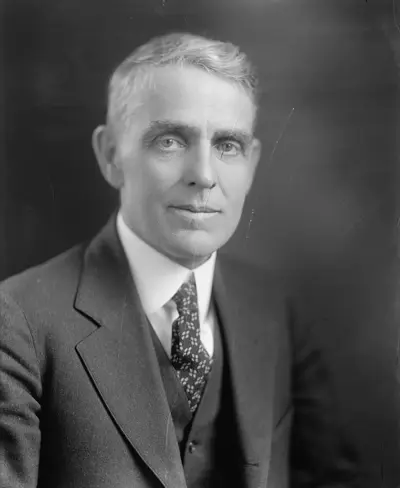
Arthur Capper was an American politician from Kansas. He was the 20th Governor of Kansas (the first born in the state) from 1915 to 1919 and a United States Senator from 1919 to 1949. He also owned a radio station (WIBW in Topeka), and was the publisher of a newspaper, the Topeka Daily Capital.
