Henry L. Stimson Quotes
The bomb and the entrance of the Russians into the war will certainly have an effect on hastening the victory.
Stimson, Henry L. Diary entry, 9 Aug. 1945. The Henry Lewis Stimson Diaries, Manuscripts and Archives, Yale University Library.

Note that he assumes that not only will there be another World War, but he assumes that we will be on opposite sides.

Prior to this the Japanese had not even considered what terms they might fight for if there were to be a peace negotiation. What the Japanese leadership apparently totally missed was the fact that President Roosevelt and all other American leaders throughout the war had promised that only unconditional surrender would be acceptable. This was reiterated in a Joint Declaration of the U. S. , China, and Great Britain. The Japanese thought this just propaganda and never took it seriously.


He was absolutely right, but Hitler paid him no heed. See {631290} for his suggested course for Germany.

Unlike many socialists who were pacifists and against WWI, Foster and the communists were supporters of the war against fascist Germany, This was one of the reasons that Nazi Germany was virulently anti-communist later.

This illustrates one of the reasons that the Israeli Arab conflict has been unsolvable over the years. A thousand years ago, the Arabs were a leading intellectual and military power in the world. The rest of the world has moved ahead and they have actually retrogressed. So the Arabs seek dignity which is very elusive. They have never wanted to negotiate terms with Israel when they have been weak and feel defeated. So the pattern has been that they feel they cannot negotiate for justice as they are too week. So periodically they attack Israel which has always defeated them and hoped that after the Arab defeat, permanent negotiations for peace could take place. But the Arabs were feeling too weak. So they just repeated all their extreme demands. After a few years, they would try another attack, lose again and the cycle would repeat. The Israelis fear that if the Arabs every won a war, the Arab moderates might be willing to reasonably negotiate, the extremists would want to continue the fighting and “drive the Israelis into the sea” as they have so often threatened.


1st Earl Lloyd-George of Dwyfor. For the earliest use of the phrase, see {41309}.

A few Americans who were too young to remember WWII hav in retrospect questioned the use of the Atomic Bomb against Japan. Young Japanese feel even stronger on this point. This quotation is very important because it comes for a senior Japanese official who knew the conditions at the time.

Very few societies ever had the wealth accumulated so that they could afford prolonged military operations. In addition, long, prolonged conflicts erode morale, both civilian and military. The Afghanistan War that went on for over a decade caused both and put a great strain on the U. S. national budget.


Bethe and other European refugees joined American and British scientists at Los Alamos, NM, for the development of the atomic bomb.

The Russians had lost over 20 million of its people to German WWII hostilities. They wanted a vengeance and were willing to take the casualties that came with the invasion of Berlin and many other key cities that were heavily defended. Eisenhower and Churchill realized that this would give the Russians a very dominant military occupation of Eastern Europe and Eastern Germany. However, they did not want to take the huge casualties of all these battles. Politically, Churchill and American leaders had to explain to their right wings why Russia was involved as an equal partner in making occupation decisions about Germany.


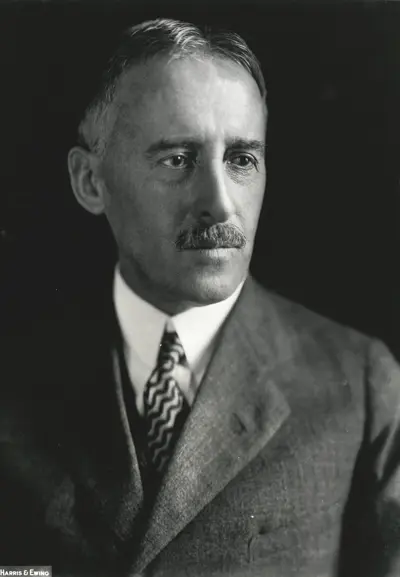
Henry Lewis Stimson was an American statesman, lawyer, and Republican Party politician. Over his long career, he emerged as a leading figure in U.S. foreign policy by serving in both Republican and Democratic administrations. He served as Secretary of War (1911–1913) under President William Howard Taft, Secretary of State (1929–1933) under President Herbert Hoover, and Secretary of War (1940–1945) under Presidents Franklin D. Roosevelt and Harry S. Truman.
