Winston Churchill Quotes
The Battle of France is over. The Battle of Britain is about to begin. Upon this battle depends the future of Christian civilisation.
Churchill, Winston. Never Give In! The Best of Winston Churchill's Speeches. Selected by Winston S. Churchill, Hyperion, 2003, p. 238.


The military security people were so used to ferreting out communists in the 1930s that they had a hard time adjusting to the fact that the security risks or people who might have German connections or backgrounds. Many immigrant scientists were recruited for work on the Manhattan project to build the atomic bomb and they only did security clearances. The military security people kept checking on any communist background they might have had as opposed to possible connections with fascist organizations. By the end of the war they had adjusted but then had to go back to looking for communists as the Cold War evolved.

De Gaulle was a very difficult ally. He was ashamed that so many of his countrymen collaborated with the German invaders including fighting against the allies and the collapse of the French Army which, although it was larger than the German invader, had exhibited much cowardice. His way of dealing with this shame was to exaggerate the positive role that the loyal French and the serious Free French Fighters and to deny the extent of the negative behavior. He was always demanding that the small Free French Army be included in all military operations, and when successful, they be given equal credit along with the British, Americans, and Russians even though the French only contributed a tiny proportion of the effort. De Gaull’s ego, personal and national was enormous and Churchill had just as great a national ego. Hence for De Gaulle, Churchill was a kind of enemy. The “Channel” referred to the English Channel.


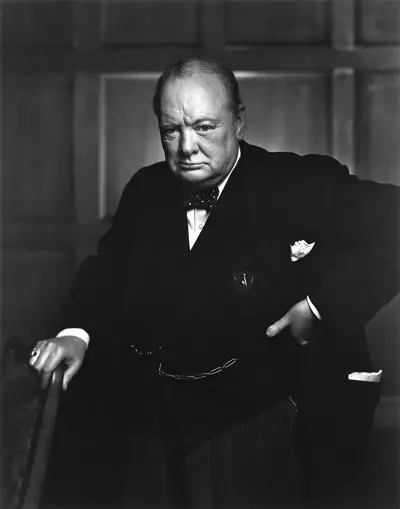
Sir Winston Leonard Spencer Churchill, KG, OM, CH, TD, DL, FRS, RA was the Prime Minister of the United Kingdom from 1940 to 1945, during the Second World War, and again from 1951 to 1955. Apart from two years between 1922 and 1924, Churchill was a Member of Parliament (MP) from 1900 to 1964 and represented a total of five constituencies. Ideologically an economic liberal and imperialist, he was for most of his career a member of the Conservative Party, as leader from 1940 to 1955. He was a member of the Liberal Party from 1904 to 1924. Churchill was also well known for his military career and as a historian, painter and writer, and among his many awards was the Nobel Prize in Literature.
