Ruhollah Khomeini Quotes
The Basiji must understand that he is a soldier of God for whom it is not so much the outcome of the conflict as the mere participation in it that provides fulfillment and gratification
The Basiji are an Iranian revolutionary organization of over 10 million young boys who have volunteered to be martyrs. They are led by men over 45 who guide them. Tens of thousands of them died in human wave attacks and mine clearing operations. See {619829}.
Ruhollah Khomeini, 1900-1989, Iranian Cleric (Ayatollah) & Revolutionary Leader, September 1980
Sourced by: Eigen's Political and Historical Quotations

Fundamentalist Muslims, like fundamentalist Jews, believe that all body parts must be buried together and these young Iranian “martyrs” were being blown to bits, thus denying them a proper Islamic burial. This was a problem which the Iranians remedied. What is fascinating about this quotation is that the proper burial was the only perceived problem that needed solving—not the fact that Iran was sacrificing tens of thousands of children to clear minefields with their bodies and certain death. The proprietary of this never received much thought. See {619826} for the leadership perception.

This particular quotation is very important. Khomeini was probably the most influential Muslim in the 20th Century. The fact that he wrote this in 1942—before there was an Israel as an enemy—shows how deep seated the requirement for world conquest is. To the Nazi’s world conquest was a justifiable goal. To Khomeini and his many followers, it is a religious obligation and duty and thus is every more dangerous. Extreme anti Muslims justify the attempted expulsion of Muslim immigrants on the grounds that they are a fifth column whose loyalty is and will be to the religion which will attempt to conquer their country. It gives Islamaphobia a veneer of respectability.

These passages of the Koran place the burden of fighting with their lives and their money when there is a jihad. In most cultures people who will not fight in their wars may be cowardly, immoral, and even criminal. But in Islam, the person is but into an even worse category—that of a non-believer. This is the worst accusation that can be made in the Islamic culture and often is accompanied by the death penalty.

If some Islamic cleric declares a war or dispute to be an attack on Islam, the penalty is indeed severe for those Muslims who do not join the fight. In some Islamic lands, unbelievers are put to death. Note that the children become the Islamic society’s hostages for the behavior of the father.


Most modern Islamic clerics were and are shocked at this interpretation of Islam,

“Zakat” is the practice of giving a percentage of one’s property to the poor. This is similar to the concept of tithing and charity in Christianity and Judaism. One difference today is that many of the Muslim nations use the religious requirements as an element of state policy and the social safety net is intertwined by state and church. The Mormon Church in early Utah had the same amalgam of church and state, but that was abandoned in favor of separation of church and state. Turkey went through the same shift in the Ataturk revolution.

He was one of the world’s greatest polymaths who among his other accomplishments was the “Father of Sociology” and was the leading Islamic intellectual of his era. This is a very important quotation because ibn Khalidun was such a monumental and respected Islamic intellect. He confirms the history that Islam was spread both by persuasion and by force. He also makes the distinction between Islam and other religions regarding war, Finally, the last sentence characterizes Islam as an aggressive, expansionist force that is a potential danger to all non-Muslim states.

The Turks could not take the city then, but they did 56 years later in 1453.

He was the first American that who was assassinated by the Central Intelligence Agency by means of a drone attack. He was a major recruiter for Al Qaeda and he preached to 3 of the 9-11 terrorists.

His views are a mix of modernism and fundamentalism. He favors democracy and elections but also favored the Taliban destroying the great ancient Buddha statues when he was called an idol worshipper for urging the preservation of art. His ignorance of modern technology Is illustrated by his complaint that the Arab nations do not even “produce a single nail” for modern cars. The reality is that there are no more nails in modern cars.
The term “slave soldiers” oversimplifies the relationships which existed in Islamic societies. For example the Sultans of the Ottoman Turks established networks of non-Muslim minorities, Christians, Jews and others who while slaves could wield tremendous power. Grand Viziers were even slaves. The slavery concept meant that the Sultan had the power of arbitrary life and death over the soldier which is what he wanted for his key units. Islamic law prohibited Muslims from holding other Muslims as slaves.


This is one of the most positive statements about women and women’s rights to emanate from a leader of a Muslim Middle Eastern nation.


of the Central Intelligence Agency fomented Iranian Revolution. At the request of the British MI6 intelligence service, the CIA implemented a “spontaneous” coup d’etat to overthrow the popularly elected Iranian President Mohammad Mosaddegh. One of the reasons this is a very important quotation is that it shows an interesting aspect if jihad—Islamic Holy War. One of the many tactics the CIA used was to bribe key Islamic Imams and other religious officials to declare a jihad against Mosaddegh—to tell the people that it was their Islamic duty to get rid of Mosaddegh who was a threat to Islam and the word of God. The quote illustrates that most of the Western powers who wanted to achieve a political objective would play this jihad religious card—one that was much easier to start than to control. When Eisenhower urged using the jihad tactic, he did not imagine that jihad would be used against the United States for the 9-11 attack and the Iraq and Iran wars. See {637008} and {637007}.
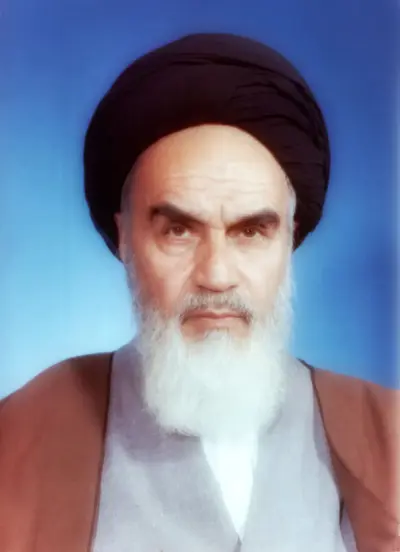
- Born: May 17, 1900
- Died: June 3, 1989
- Nationality: Islam
- Profession: Statesman
Sayyid Ruhollah Musavi Khomeini, also known in the Western world as Ayatollah Khomeini, was an Iranian political and religious leader. He was the founder of the Islamic Republic of Iran and the leader of the 1979 Iranian Revolution, which saw the overthrow of the last Shah of Iran, Mohammad Reza Pahlavi, and the end of the 2,500-year-old Persian monarchy. Following the revolution, Khomeini became the country's Supreme Leader, a position created in the constitution of the Islamic Republic as the highest-ranking political and religious authority of the nation, which he held until his death. Most of his reign was taken up by the Iran–Iraq War of 1980–1988. He was succeeded by Ali Khamenei on 4 June 1989.
