Washington Irving Quotes
The American fur companies keep no established posts beyond the mountains. Everything there is regulated by resident partners; that is to say, partners who reside in the tramontane country, but who move about from place to place, either with Indian tribes, whose traffic they wish to monopolize, or with main bodies of their own men, whom they employ in trading and trapping. In the meantime, they detach bands, or “brigades” as they are termed, of trappers in various directions, assigning to each a portion of country as a hunting or trapping ground. In the months of June and July, when there is an interval between the hunting seasons, a general rendezvous is held, at some designated place in the mountains, where the affairs of the past year are settled by the resident partners, and the plans for the following year arranged. To this rendezvous repair the various brigades of trappers from their widely separated hunting grounds, bringing in the products of their year's campaign. Hither also repair the Indian tribes accustomed to traffic their peltries with the company. Bands of free trappers resort hither also, to sell the furs they have collected; or to engage their services for the next hunting season.
A Documentary of the Fur Trade in America
Washington Irving, 1783-1859, Author and U.S. Diplomatic Attache to Spain, The Adventures of Captain Bonneville
Sourced by: Eigen's Political and Historical Quotations

The reason for the secrecy was that he was informing Congress of the Lewis & Clark Expedition. Potentially, the Spanish, English or French might try to interfere with the expedition which was the precursor to American domination of the entire continent. Unfortunately, Jefferson’s plan for the Indians was not supported by many other Americans with the exception of New York State and the Iroquois remaining after many left after supporting the British in the Revolution. But the Iroquois who remained were already farmers in fixed communities and were experienced traders. Further, they had a complex governmental structure with many elements of democracy, and several had already succeeded in European educational settings. Their successful integration with the rest of New York can be demonstrated by the fact that New York is the only state where the average Native American Income is the same as the average white income, and there is no Indian gaming in New York. Jefferson’s vision, unfortunately, was never implemented in early the Westward Expansion.
Like many of Jefferson’s ideas, this one had great merit but could not be enforced. The idea was to establish “trading houses” amongst the Indians which would operate on a NON PROFIT basis. However, fraud and corruption on the part of the managers of these trading houses in most cases left the Indians with far less than the fair market value of their goods and the “white” commodities were sold at inflated prices. Jefferson also believed in minimal government so he never set up any kind of audit mechanism or supervisory system of the “trading houses” and instead of helping the Indians often cheated them even more than private traders would.


Mao Tse Tung in a similar situation with steel dependency upon the West went in the opposite direction. Everyone learned to make steel, and every village to have a small smelter. The Eastern Iroquois learned to make and repair guns thereby avoiding dependency. But The Prophet chose the alternative of tradition and boycott. It was ineffective. The gun was a much better hunting device and the Indians knew that. The anti-modernity approach has never worked.


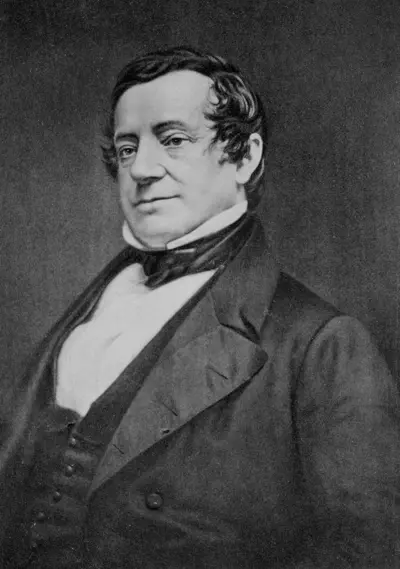
Washington Irving was an American short-story writer, essayist, biographer, historian, and diplomat of the early 19th century. He is best known for his short stories "Rip Van Winkle" (1819) and "The Legend of Sleepy Hollow" (1820), both of which appear in his collection The Sketch Book of Geoffrey Crayon, Gent. His historical works include biographies of Oliver Goldsmith, Muhammad and George Washington, as well as several histories of 15th-century Spain that deal with subjects such as Alhambra, Christopher Columbus and the Moors. Irving served as American ambassador to Spain in the 1840s.
