James Hamilton Quotes
… that unhappy Act of Parliament which invested German settlers with the Rights of Englishmen before they knew how to use them.
There had been no tradition of self government or even rights in Germany and some like Hamilton thought that the immigrants from such a totalitarian tradition would not handle the relative freedom of America. They were wrong.
James Hamilton, 1710-1783, Lieutenant-Governor of Pennsylvania, Mayor of Philadelphia, President of the American Philosophical Society, Reference to the German immigrants who were coming into Pennsylvania, ~1747, Quoted in Schwartz, Mixed Multitude
Sourced by: Eigen's Political and Historical Quotations

This was in effect a “Real Estate Promotional Document. Unlike the New England colonies the Carolinas had freedom of and from religion right from the beginning and it was used as an advertising point to get colonists. See {611573} and {611571} for other “features.”


Most people are very surprised that the great Benjamin Franklin was so narrow-minded at one point in his life. The German immigration almost halted during the Seven Years War, and the influx of Germans to Pennsylvania did not resume at the same rate.

Bourne was one of the first writers with a national audience to question the classic but never real “melting pot” theory of immigration and suggest the “salad” model though he never used the term.

Carson was one of the few Indian Agents who spent every penny of his budget on the Indians as opposed to himself. He was married to an Indian woman and was close enough to many Indians that he understood their resentment whenever they came into a town. They were treated terribly and while most of them were literally starving, seeing the white opulence produced resentment.

At the time, some Palestinian Arabs claimed exclusive rights to the territory on the grounds that Arabs had dominated the area for the longest period of time. They gave no credence to the fact that the Jews had dominated the area and it was the center of their kingdom for many years before—that Jews had constantly lived in the area of longer than the Arabs, nor did they give any credence to the fact that the Christians had conquered the area from the Muslims during the Crusades.

Brant had an English style Missionary education and was an Anglican, belonging to the Church of England. During the American Revolution, he persuaded most of the Iroquois tribes to fight for the British against the revolutionary colonists. However, the Oneida tribe was not persuaded and joined the rebel side. A few New England Presbyterian missionaries had targeted the Oneida people, and when that tribe chose the “wrong” side, Brant believed that the reason was their different religious point of view. After the Revolution, Brant and his Iroquois followers were driven out of their American lands and escaped to Canada, while the Oneida were given complete title to their lands by George Washington.

The colonists in America had no representatives in Parliament. Galloway who opposed armed rebellion against Britain {621966} admitted that the British treatment of America was wrong but saw other solutions. It will never be known if any of them might have worked. The world would have been very different had they been tried.
Hopkins was complaining about the fact that England could tax the colonies and thereby take their property without their consent made the American colonists in the “miserable condition of slaves.” Essentially the fundamental complaint of the Americans was this and in a decade it would erupt as the American Revolution. At the same time, Hopkins was a slave owner and yet saw nothing wrong with that.


“Service” referred to what was then the 7 year time of apprenticeship that a typical American apprentice was required to work for a master tradesman before he was given colonial citizenship and allowed to trade for himself. Under the bill that was passed anyone could come to the British American colonies (except Jews) by taking an oath of allegiance and paying a small fee. Holland and some thought that it discriminated against those apprentices who had come before and apprenticed themselves thus “playing by the rules.” Ever since, immigration and citizenship debates have faced the tension between the need for labor in America and the fairness to the people who had followed the earlier existing rules restricting immigration.


_0_thumbnail_47x47.jpg)


The Irish Earls of Ulster, after a failed rebellion against English rule, fled to the European continent. As Chichester realized, this created an opportunity for the King to name new Earls and grant them the lands and possessions of the Earls who had fled. And since the Irish people were loyal to their traditional Earls. He suggested that English and Scots colonists be recruited to settle the lands. The King agreed and referred to the project as the “Ulster Plantation”. This was the reason that Northern Ireland had a much larger Protestant population percentage than the rest of Ireland and wanted to remain part of England when Ireland obtained its independence.

He lost be 2 votes.

The early Zionists had an understanding of how they were then perceived by the Arabs who had been living in land that was to become Israel. Like most other parts of the world, the land of Israel has been conquered and reconquered over the years. The area had been a Jewish kingdom in the immediate centuries before the birth of Christ. They had conquered it from the tribes that had conquered it from the Egyptians who had also conquered it. Then the Romans conquered. After that there were Muslims, Christians, the Ottoman Empire, the British and finally Israel was formed. Throughout this entire history, both Arabs and Jews had lived on the land along with and under the authority of whoever was the latest conqueror. In the hundreds of years before the establishment of the state of Israel, the Arabs had been in the majority. The 20th century saw a large influx of Jews who immigrated, purchased land and settled. There had been low level conflict as the Arabs became concerned that with the immigration

At that time, Russia and Germany were autocracy, and the ruler could simply take the English money and force the soldiers to fight in a war they had not stake in nor understood.

The Boers were lower class, uneducated, farmers from Holland who came to South Africa before the English did. They were at the bottom of the Dutch socioeconomic ladder. Unlike the English who were interest in establishing a trading colony, the Boers just wanted to own and farm the land and use blacks as slave or cheap labor. The Dutch Government and Trading companies lost interest in South Africa as there were much more profitable parts of the world, and they felt no obligation to the Boers whom they were glad to be rid of. So the Boers found themselves having to follow the British laws and rules of the British Colonial Office. Slavery was outlawed, and Blacks could be educated and become citizens under British law. They could own land, and contest the right of the Boers who had settled in some uninhabited land and some that was owned by Black tribes. The Blacks outnumbered the whites in general and the Boers, and there were educated Blacks who “outclassed” the still relatively uneducated Boers. So the Boers, fighting for their “way of life” set up their own area in Southern Africa and claimed independence. But Blacks claimed that it was their land and looked to the British to exercise English law. The Boer war ensued. Although the Boers lost the war, the bred at a much faster rate than the English, many of whom did not even have their families in South Africa. By the end of WWII, the Boer white majority controlled the government and kept the majority Blacks from voting and having full citizenship rights. They dominated Apartheid South Africa until the Black Revolutionists obtained control and although Black and white relations are better in South Africa than most countries, the extemeist Boers and most militant Blacks are in political, but not violent, conflict. Churchill and the British have always perceived themselves as being caught in the middle between the Boers and the Blacks.
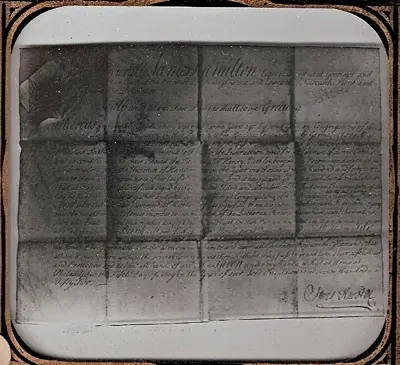
James Hamilton, son of the well-known American lawyer Andrew Hamilton, was a prominent lawyer and governmental figure in colonial Philadelphia and Pennsylvania. He served as Deputy Governor of the Province from 1748 to 1754 and again from 1759 to 1763.
